Coding Math Requirements Finder
Curious about how much math you actually need? Select a coding path below to see the math requirements and key concepts.
Web Development
Mobile Apps
Game Dev
AI / Data Science
Cybersecurity
Algorithms & Logic
Select a path to see details
Click on any of the categories above to explore the mathematical concepts involved.
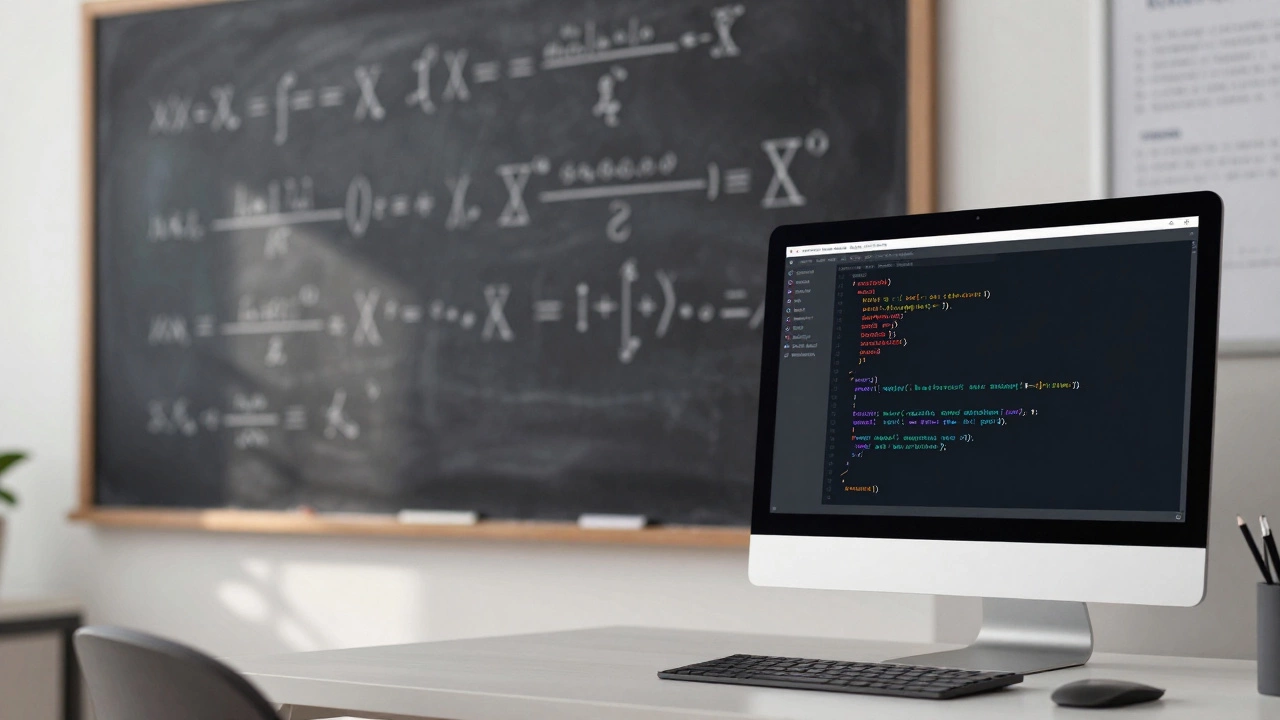
You've probably heard a horror story about a programmer staring at a chalkboard full of Greek symbols and complex calculus. If you're staring at a coding math requirements list and feeling a knot in your stomach, here is the truth: for 90% of people starting out, the answer is a resounding "not really." You don't need to be a math genius to build a website, automate a boring spreadsheet, or create a mobile app. Most of the time, coding is more about how you organize your thoughts than how you solve for X.
Quick Takeaways: Math and Code
- Basic arithmetic (addition, subtraction, multiplication, division) is enough for most web and app development.
- Logic and problem-solving are the real "math" of programming.
- Specific fields like Game Dev, AI, and Data Science do require advanced math (Calculus, Linear Algebra).
- You can learn the math as you go; you don't need a degree in it to start writing code.
The Big Misconception About Math in Programming
People often confuse "mathematics" with "logic." Programming is the process of creating a set of instructions that tell a computer how to perform a task . While computers are essentially giant calculators, the act of writing code is more like writing a recipe. If you can follow a set of instructions or organize a grocery list, you already have the mental framework needed for coding.
Think about building a simple login page. You aren't calculating the trajectory of a rocket. You're asking the computer: "Does the password the user typed match the password in the database? If yes, let them in. If no, show an error." That's not algebra; that's boolean logic. You're dealing with true/false statements, not quadratic equations.
Where Math Actually Hits the Road
Depending on what you want to build, your math needs will vary wildly. It's not a one-size-fits-all deal. For instance, if you're diving into Front-end Development is the practice of producing HTML, CSS and JavaScript for a website so that a user can see and interact with them , you'll mostly deal with basic geometry and percentages. You need to know how to center a box on a screen or make a column take up 33% of the page. That's basic arithmetic, not rocket science.
However, some niches are mathematically heavy. If you want to get into Machine Learning is a type of artificial intelligence that allows software applications to become more accurate at predicting outcomes without being explicitly programmed to do so , you'll run into Linear Algebra and Calculus. Why? Because AI is basically just massive amounts of matrix multiplication and optimization problems. You can't hide from the math there, but you can learn it *while* you build your models.
| Field | Math Level | Key Concepts Used |
|---|---|---|
| Web Development | Basic | Addition, Percentages, Basic Logic |
| Mobile App Dev | Basic/Intermediate | Coordinate Systems (X, Y), Basic Logic |
| Game Development | High | Trigonometry, Vector Math, Physics |
| Data Science / AI | Very High | Statistics, Linear Algebra, Calculus |
| Cybersecurity | Intermediate | Number Theory, Cryptography (Prime Numbers) |
The Real Hero: Discrete Mathematics
If you want to study the "math of coding," don't look at high school algebra. Look at Discrete Mathematics is the study of mathematical structures that are fundamentally discrete rather than continuous . This is where the magic happens. Discrete math covers things like set theory, graph theory, and combinatorics. These concepts are the backbone of Algorithms, which are the step-by-step procedures for solving a problem.
For example, when Google Maps finds the shortest route from your house to a coffee shop, it's using graph theory. It treats every intersection as a "node" and every road as an "edge." This isn't the kind of math where you're solving for Y in a classroom; it's the kind of math that allows you to structure data efficiently. Understanding this makes you a better coder, but you can still be a highly paid developer without ever having a formal class in it.
Why Logic is More Important Than Arithmetic
Coding is essentially a game of "If This, Then That." This is known as conditional logic. Most of your time will be spent thinking through edge cases. Imagine you're coding a checkout page for an online store. You don't need to calculate the sum of a series (the computer does that with a simple `+` sign), but you do need to think through the logic:
- If the user has a discount code, subtract the value from the total.
- If the total is over $50, set shipping to $0.
- If the credit card is expired, trigger an alert.
- If the item is out of stock, disable the "Buy" button.
This is logical sequencing. It's about breaking a big, scary problem into tiny, manageable pieces. This skill-decomposition-is what makes a great programmer. Whether you were a straight-A student in math or you barely survived middle school algebra, your ability to think logically is the only prerequisite that truly matters.

Practical Tips for the Math-Phobic Beginner
If you're still nervous, remember that modern coding is very different from the early days of Assembly or C. We have libraries and frameworks that do the heavy lifting for us. You don't need to write a formula to calculate a circle's area from scratch; you can use a built-in function like `Math.PI` in JavaScript that does it for you in one line.
Start by focusing on the language syntax. Learn how to declare variables, write loops, and create functions. As you build projects, you'll eventually hit a wall where you realize, "I need to know how to rotate this image 45 degrees." At that moment, you'll look up the specific math (in this case, a bit of sine and cosine) and apply it. Learning math in the context of a real problem is 10x more effective than reading a textbook in a vacuum.
Common Pitfalls to Avoid
One of the biggest mistakes beginners make is spending six months studying algebra before they write their first line of code. This is a recipe for burnout. Coding is a craft, like woodworking. You don't study the physics of wood for half a year before you try to build a birdhouse; you start building and learn the physics when the birdhouse falls apart.
Don't let a lack of math confidence stop you from taking a coding class. Most bootcamps and online courses are designed for people from all backgrounds-marketing, art, nursing, and retail. They know that the logic of a loop is more important than the formula for a parabola. If you can use a calculator and you can think logically, you're already qualified to start.
Do I need to know Calculus to learn Python?
Absolutely not. Python is widely used for everything from simple automation scripts to massive web back-ends. Unless you are specifically using Python for high-level physics simulations or advanced financial modeling, you will never need to touch a derivative or an integral.
What is the most useful type of math for a general programmer?
Boolean logic and basic algebra are the most useful. Understanding how AND, OR, and NOT operators work will help you write cleaner conditions and more efficient code. Once you're comfortable, exploring basic Discrete Math can help you understand how data structures like arrays and linked lists actually work.
Can I get a job in tech if I'm bad at math?
Yes. There are thousands of developers working in web development, UI/UX, and software testing who struggle with math. Companies care more about your ability to solve problems, write clean code, and collaborate with a team than your ability to solve a geometry proof.
Is there a specific course to learn "coding math"?
Instead of a generic math course, look for courses on "Algorithms and Data Structures." These teach you the mathematical way of thinking that applies to coding without forcing you to memorize endless formulas from a 1980s textbook.
Will I need math for CSS and HTML?
For HTML and CSS, you'll mostly use basic addition and subtraction to manage spacing (margins/padding) and percentages for layout. If you can calculate a 20% discount at a store, you have all the math you need for modern web design.