NEET Time Management Calculator
NEET is a speed test - you have 1 minute per question. This calculator helps you allocate time per section based on your strengths and target score.
Configure Your Study Plan
Your Optimal Time Allocation
Based on your input, you should allocate time this way:
Passing NEET isn’t about memorizing facts. It’s about training your brain to solve the right problems, under pressure, in the shortest time possible. If you’re asking how to practice for NEET, you’re already on the right track. But most students waste months doing the same thing over and over-reading the same chapters, watching the same videos, and then wondering why their scores don’t move. Here’s how to actually get better.
Start with the syllabus, not the books
The NEET syllabus is published by NTA every year. It’s not long. For biology, it’s 38 chapters from Class 11 and 12 NCERT. For chemistry, it’s 14 units covering physical, organic, and inorganic. Physics? 20 core topics. That’s it. No extra books. No coaching modules. Just those.
Most students buy 10 different books and never finish one. Instead, print out the official NEET syllabus. Put a checkmark next to every topic you’ve mastered. If you don’t know what’s on the list, you’re not practicing-you’re guessing. The exam only tests what’s in the syllabus. Everything else is noise.
Master NCERT like it’s your mother tongue
Over 80% of NEET questions come directly from NCERT textbooks. Not paraphrased. Not twisted. Straight from the lines. In 2024, 127 out of 180 questions were word-for-word or nearly identical to NCERT content. That’s not a coincidence. That’s the pattern.
Don’t read NCERT once. Read it three times. First pass: read for understanding. Second pass: underline every definition, diagram label, and example. Third pass: close the book and write down everything you remember. If you can’t recall the exact wording of a diagram caption or a biological process step, you haven’t mastered it.
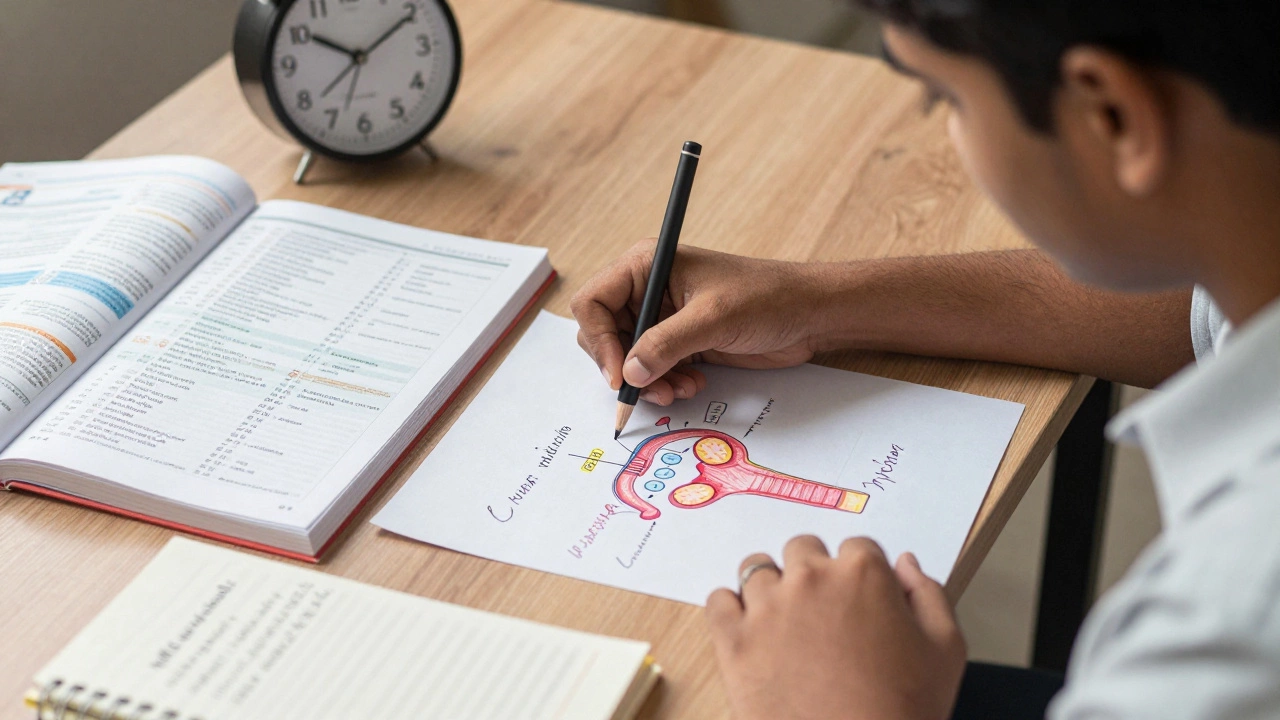
Try this: pick one biology chapter-say, Human Reproduction. After reading it, close the book and draw the entire male and female reproductive system from memory. Label every part. Write the function of each hormone. If you miss even one structure, go back. Repeat until you can do it in under five minutes without looking.
Practice with past papers-not random MCQs
NEET doesn’t test your knowledge of random facts. It tests how you think under exam conditions. That means you need to train with real questions from past papers. Not coaching institute mock tests. Not apps with 50,000 shuffled questions. Only NTA’s official papers from 2019 to 2025.
Start with the 2023 paper. Time yourself. 180 questions in 180 minutes. No breaks. No phone. No distractions. After you finish, mark it. Don’t just note your score. Note why you got each question wrong.
Was it a concept gap? Then go back to NCERT. Was it a silly mistake? Circle it. Was it a time issue? Track how long you spent on each section. If you spent 40 minutes on physics and only 30 on biology, you’re not managing time-you’re losing marks.
By the time you’ve done five full papers, you’ll start seeing patterns. NTA loves asking about: the structure of DNA, the mechanism of enzyme action, the function of the cerebellum, and the chemical equations in organic chemistry. They repeat. Not because they’re lazy. Because those are the core concepts.
Build a mistake journal-not a revision notebook
Most students keep a revision notebook. They write down everything they learn. That’s useless. You don’t need to remember everything. You need to stop repeating the same mistakes.
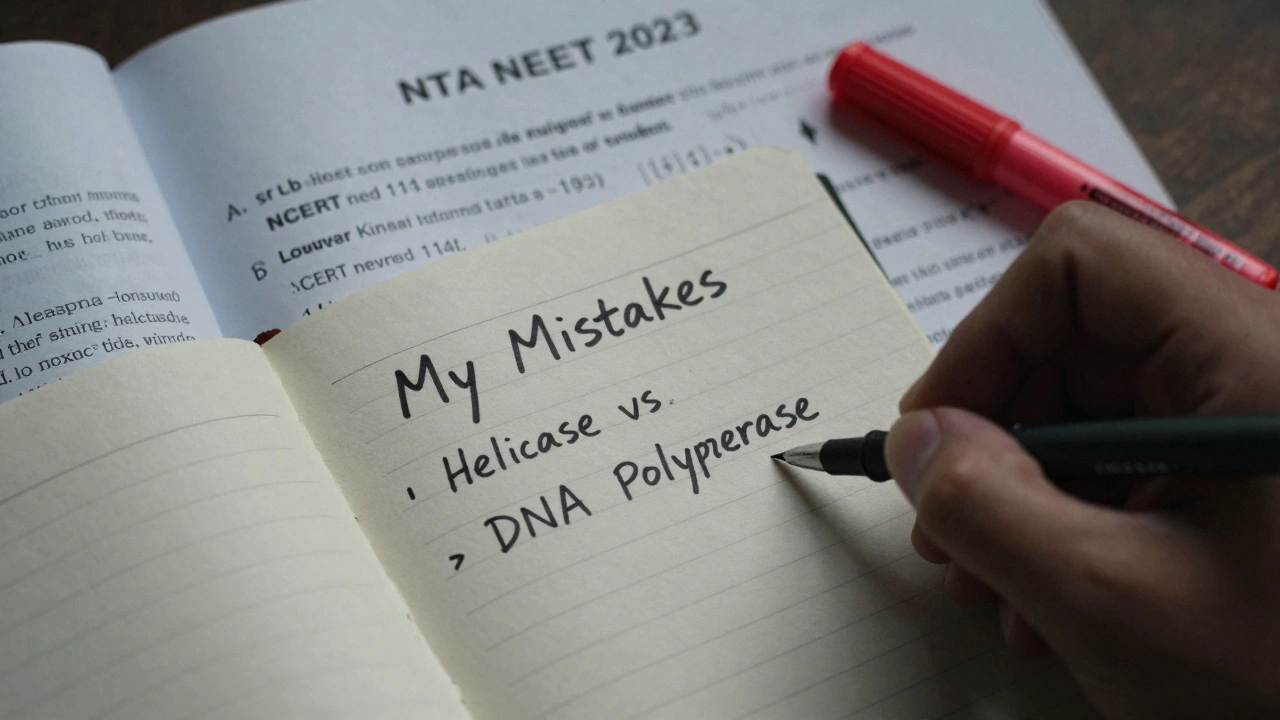
Get a small notebook. Title it: My Mistakes. Every time you get a question wrong, write:
- The exact question (or paraphrase it)
- Why you got it wrong (misread? forgot? confused two concepts?)
- The correct logic
- The NCERT page number where it’s explained
Example:
Question: Which enzyme is responsible for unwinding DNA during replication?
My mistake: I picked DNA polymerase. I thought all DNA enzymes do the same thing.
Correct answer: Helicase. DNA polymerase adds nucleotides. Helicase breaks hydrogen bonds to unwind the strand.
NCERT page: 114, Class 12 Biology, Chapter 6
Review this journal every Sunday. In two months, you’ll stop making the same errors. That’s how scores jump-from 500 to 650.
Time management is your secret weapon
NEET is not a knowledge test. It’s a speed test. You have one minute per question. That includes reading, thinking, eliminating options, and bubbling the answer.
Here’s how to train for it:
- Start with 30 questions. Set a timer for 30 minutes.
- When the timer ends, stop. Even if you haven’t finished.
- Mark what you did. Then finish the rest without timing.
- Compare your timed accuracy vs. untimed accuracy.
If your untimed accuracy is 90% but your timed accuracy is 65%, you’re not weak in content-you’re weak in pacing. You’re spending too long on hard questions.
Solution: Learn to skip. If a question takes more than 90 seconds, flag it and move on. Come back only if you have time. Most students lose 15-20 marks because they get stuck on one or two questions. That’s 50-70 rank points.
Simulate exam day-every week
NEET happens in May. But your brain doesn’t know that. It needs to believe it’s already in the exam hall.
Every Sunday, do a full mock test. Same time. Same conditions. No snacks. No water during the test. Wear the same clothes you’ll wear on exam day. Sit at a desk. Use an OMR sheet. Use a pen you’ve practiced with.
After the test, analyze:
- Which section drained your energy? (Usually physics)
- Which topics made you anxious? (Usually organic chemistry)
- Did you run out of time in the last 20 minutes?
Adjust your strategy. If physics always drains you, do it first. If biology is your strength, do it last to build confidence. There’s no ‘right’ order-only what works for you.

Stop comparing. Start tracking.
Don’t check how many students scored 700+. Don’t watch YouTube videos of toppers. You’re not them. You’re you. And your progress is measured in small, daily wins.
Track your weekly scores. Not your rank. Not your percentile. Just your raw score. Did you go from 480 to 510 in two weeks? That’s progress. Did you reduce your mistakes in biology from 15 to 8? That’s progress.
Progress isn’t loud. It’s quiet. It’s the extra 10 minutes you spent drawing diagrams. It’s the question you skipped last week but nailed this week. It’s the confidence you feel when you see a question you’ve seen before.
What to avoid at all costs
- Don’t join 10 coaching classes. One good one is enough. The rest just add stress.
- Don’t buy 10 mock test series. Use NTA papers. That’s all you need.
- Don’t study 16 hours a day. Your brain needs rest. Sleep 7 hours. Take one day off a week.
- Don’t ignore your health. Eat well. Drink water. Walk for 20 minutes daily. Burnout kills more aspirants than failure.
NEET is a marathon. Not a sprint. The people who win aren’t the ones who know the most. They’re the ones who practiced the right way, consistently, for months.
You don’t need to be the smartest. You just need to be the most prepared.
Can I crack NEET without coaching?
Yes, absolutely. Over 40% of top scorers in 2024 were self-prepared. Coaching helps with structure, but not content. If you have discipline, NCERT, past papers, and a mistake journal are all you need. Many students waste money on coaching that just repeats what’s already in their textbooks.
How many hours should I study daily for NEET?
Quality matters more than quantity. Six focused hours with active practice-like solving past papers and reviewing mistakes-are better than 10 hours of passive reading. Most successful candidates study 5-7 hours a day, six days a week. One day off is non-negotiable for mental recovery.
Is biology more important than physics in NEET?
Biology has 90 questions-half the paper. Physics and chemistry have 45 each. So yes, biology carries the most weight. But physics is harder to score in. Many students lose 20-30 marks in physics because they skip formulas or misapply concepts. Focus on biology for volume, but don’t ignore physics. A balanced approach gives the best results.
Should I solve previous year papers multiple times?
Yes. The first time, you’re learning the pattern. The second time, you’re improving speed. The third time, you’re spotting traps. NTA reuses concepts-even if they change the wording. Solving the same paper three times with timed conditions will train your brain to recognize what’s coming.
What’s the best time of day to study for NEET?
NEET is held in the morning. So train your brain to be sharp between 9 AM and 12 PM. If you study at night, your body won’t be ready on exam day. Shift your study schedule to mornings. Start with 30 minutes, then increase. After a week, you’ll feel more alert during that time.
Next steps: Your 30-day action plan
- Week 1: Print the NEET syllabus. Mark every topic you’ve covered in NCERT.
- Week 2: Complete one full past paper (2023). Analyze every wrong answer.
- Week 3: Start your mistake journal. Add 5 new entries every day.
- Week 4: Do your first full mock test under exam conditions.
By the end of 30 days, you won’t just know what to do. You’ll know you can do it. That’s the real edge.