
Interactive Teaching Strategy Guide
Select a core strategy below to reveal expert tips, implementation steps, and potential pitfalls based on best practices for new instructors.
Total Physical Response (TPR)
Linking movement to meaning.
Vocabulary First
High-frequency words & context.
Language-Rich Environment
Immersion through labels & routine.
Scaffolding Communication
Supporting speaking & writing skills.
Walking into a classroom full of students who share zero common vocabulary with you is one of the most terrifying experiences in education. You open your mouth to explain a concept, and they stare back with blank expressions. Panic sets in. But here is the secret that veteran teachers know: beginners do not need perfect grammar explanations or complex linguistic theories. They need connection, repetition, and safety.
Teaching English for beginners is the process of introducing foundational language skills including basic vocabulary, simple sentence structures, and essential communication strategies to learners with little to no prior knowledge. It requires a shift from explaining rules to demonstrating meaning. If you are new to this role, you might feel overwhelmed by the sheer volume of material. However, by focusing on high-frequency words and immersive techniques, you can create an environment where students start speaking within their first few lessons.
Understanding the Beginner Mindset
Before you plan a single lesson, you must understand what your students are going through. Learning a new language at a beginner level is physically and mentally exhausting. Their brains are working overtime to decode sounds, associate images with words, and form muscle memory for pronunciation. This cognitive load means they cannot absorb long lectures.
Most beginners suffer from language anxiety, a fear of making mistakes that paralyzes them. Your primary job is not just to teach English; it is to lower this affective filter. When a student feels safe, their brain opens up to input. If they feel judged, they shut down. Create a classroom culture where mistakes are celebrated as evidence of trying. Laugh at your own errors. Show them that communication is more important than perfection.
Also, recognize that "beginner" does not mean "empty." Students bring life experience, cultural context, and other languages with them. Use these assets. If a student speaks Spanish, use cognates (words that look similar) to build confidence quickly. If they are visual learners, lean heavily on images. Understanding your audience’s background allows you to tailor examples that resonate personally, making the language stick faster.
The Power of Total Physical Response (TPR)
One of the most effective methods for teaching absolute beginners is Total Physical Response (TPR), a language teaching method based on coordinating speech and physical movement. Developed by psychologist James Asher, TPR mimics how children learn their first language: by listening and doing before speaking.
Instead of writing "stand up" on the board and translating it, you say "Stand up" while standing up yourself. Then you point to a student and say "Stand up." The student stands. You praise them. Repeat this with "sit down," "walk," "jump," and "touch your nose." Within minutes, students have learned five verbs without hearing a single word of explanation in their native tongue.
This method works because it bypasses the translation step in the brain. The student connects the English sound directly to the action. As you progress, combine commands: "Walk to the door and touch it." This introduces prepositions and sequencing naturally. TPR is especially powerful for teaching:
- Action verbs (run, eat, sleep)
- Body parts (head, shoulders, knees)
- Classroom objects (book, pen, desk)
- Directions (left, right, forward)
Keep movements exaggerated and clear. Your body becomes the textbook. This reduces ambiguity and keeps energy levels high in the room.
Vocabulary First, Grammar Later
A common mistake new teachers make is trying to explain grammar rules too early. Do not start with the present continuous tense formula. Start with the words needed to survive. Focus on high-frequency vocabulary that offers immediate utility. According to linguistic research, the top 1,000 words in English account for approximately 75% of all spoken conversation. Mastering these gives students a massive return on investment.
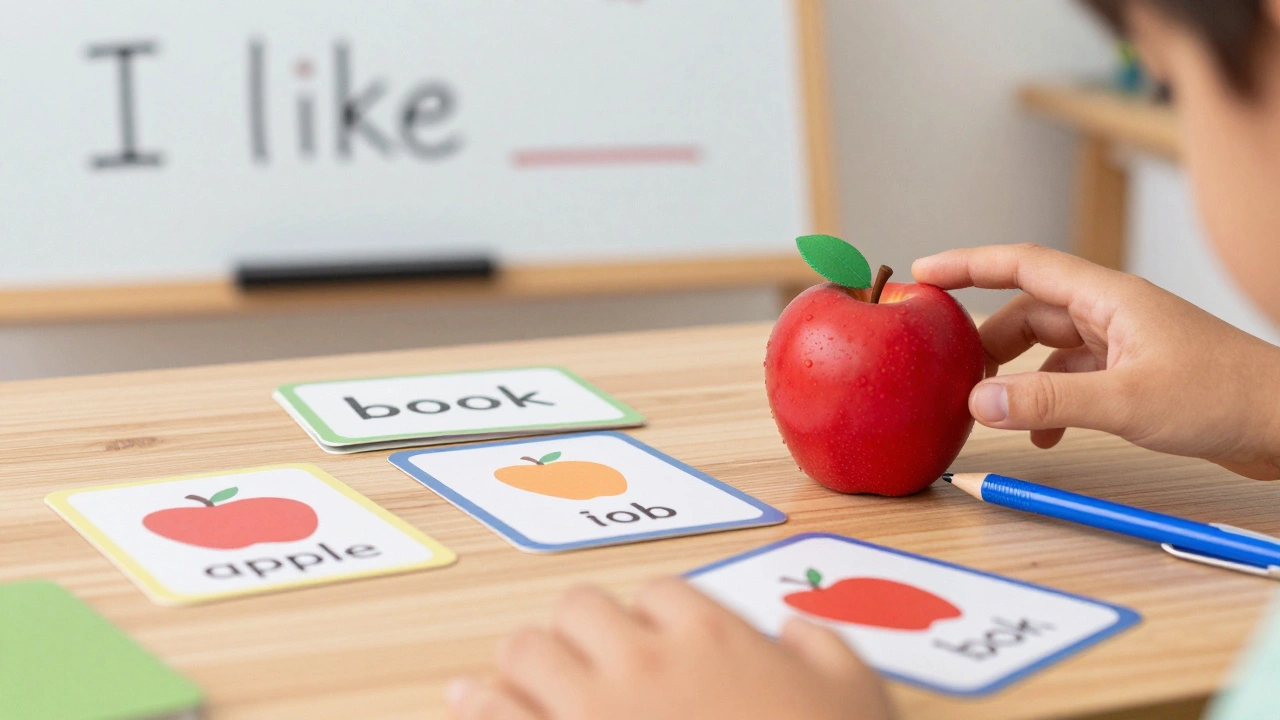
Organize vocabulary into thematic chunks rather than isolated lists. Instead of teaching random animals, teach "At the Supermarket" or "My Daily Routine." Context helps memory. When you teach the word "apple," show a real apple or a clear picture. Say "Apple" three times. Have students repeat. Then put it in a sentence: "I eat an apple." Avoid defining the word using complex synonyms. Use visuals, gestures, and realia (real-life objects).
Use flashcards, but don’t stop there. Play games like "Pictionary" or "Charades" to reinforce the words. Repetition is key, but it must be varied. Say the word, write the word, draw the word, act out the word. Multi-sensory learning ensures that if one pathway fails, another triggers the memory.
Creating a Language-Rich Environment
Your classroom should speak English even when you are silent. Label everything. Put sticky notes on the door, window, table, chair, and clock. Write the word clearly and read it aloud every time you point to it. Over time, students will begin to recognize these words automatically.
Use consistent routines. Start every class with the same greeting song or chant. End with a predictable goodbye phrase. Predictability reduces anxiety. When students know what comes next, they can focus on the language itself rather than wondering about the structure of the lesson.
Incorporate songs and rhymes. Children’s songs are excellent for beginners because they use simple, repetitive language and strong rhythms. Songs like "Head, Shoulders, Knees, and Toes" or "If You’re Happy and You Know It" teach vocabulary and grammar patterns subconsciously. Singing lowers inhibition and makes pronunciation practice feel like play rather than work.
Scaffolding Communication Skills
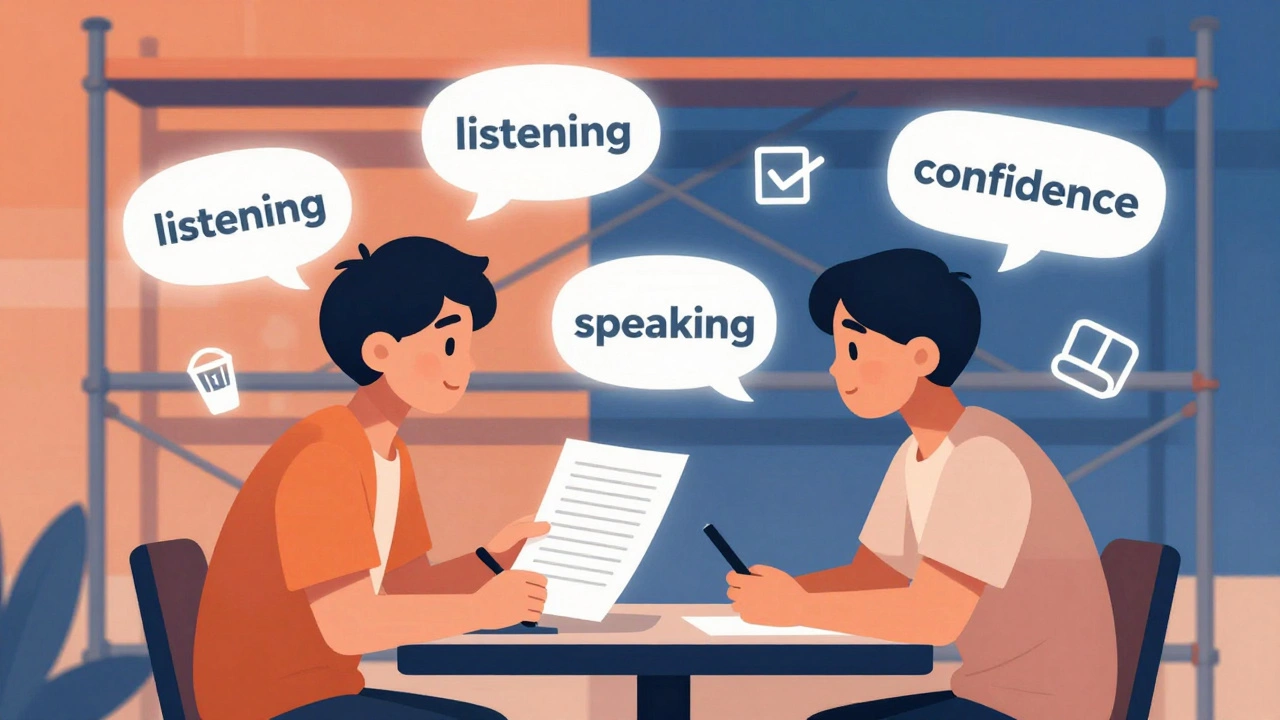
As students gain confidence, move from receptive skills (listening and reading) to productive skills (speaking and writing). Scaffolding is the support you provide to help them reach higher levels of understanding. Think of it as training wheels for a bicycle.
Start with controlled practice. Provide sentence frames: "I like _______" or "This is a _______." Fill in the blanks together. Then, gradually remove the support. Ask open-ended questions: "What do you like?" Encourage short answers initially. Accept broken English if the meaning is clear. Correct errors gently and selectively. Do not interrupt every mistake. Focus on one error type per session. If today’s focus is verb conjugation, ignore spelling mistakes for now.
Pair students for simple dialogues. Give them scripts to memorize first, then encourage improvisation. Role-playing scenarios like ordering food, asking for directions, or introducing oneself builds practical competence. Real-world application motivates learners because they see the immediate value of their efforts.
| Strategy | Best For | Key Benefit | Potential Pitfall |
|---|---|---|---|
| Total Physical Response (TPR) | Action verbs, commands | High engagement, low anxiety | Hard to scale for large groups |
| Visual Flashcards | Nouns, adjectives | Quick association building | Becomes boring without variation |
| Songs & Rhymes | Pronunciation, rhythm | Memorable, fun atmosphere | Lyrics may contain complex slang |
| Role-Play | Conversational phrases | Real-world application | Students may revert to native language |
Managing Classroom Dynamics
Beginner classes often face unique behavioral challenges. Some students dominate due to natural extroversion, while others hide in the back. Balance participation by using cold-calling gently and providing think-time before answering. Use group work strategically. Mix confident speakers with quieter students so peers can model behavior.
Establish clear signals for attention. A clap pattern, a raised hand, or a specific chime works better than shouting over noise. Consistency is crucial. If you change signals daily, confusion reigns. Train your students on these protocols during the first week.
Monitor pair and group work closely. Beginners tend to switch to their native language instantly when left unsupervised. Walk around, listen, and intervene politely. Remind them of the "English Only" rule, but frame it positively: "We are practicing our English muscles!" Offer incentives for staying on track, such as points toward a class reward.
Assessing Progress Without Tests
Traditional tests often fail beginners because they require reading comprehension and written expression that students haven’t yet developed. Use alternative assessment methods. Observation is powerful. Keep a notebook and note which students can follow instructions, which can name objects, and which can ask simple questions.
Portfolios are effective. Collect drawings labeled with English words, recordings of students singing songs, or videos of role-plays. Review these periodically to show students their growth. Seeing their own progress boosts motivation significantly.
Oral quizzes are less intimidating. Ask one-on-one questions during casual moments. "What color is your shirt?" "Do you like coffee?" Record the responses informally. This data helps you adjust your pacing. If half the class struggles with a concept, slow down and revisit it with different activities.
Staying Motivated as a Teacher
Teaching beginners can be repetitive. You will say "Hello" and "Goodbye" thousands of times. Burnout is real. Protect your energy by varying your delivery. Change your tone, use props, invite guest speakers, or take lessons outdoors if possible.
Celebrate small wins. Did a shy student answer a question? Praise them publicly. Did the class finally pronounce "th" correctly? Throw a mini-party. Positive reinforcement creates a feedback loop of success. Remember why you started. Every word a student learns opens a door to a broader world. Your patience and creativity are the keys that unlock those doors.
Connect with other teachers. Share resources, vent frustrations, and exchange ideas. Isolation kills enthusiasm. Join online communities or local teacher associations. Learning from peers keeps your methods fresh and your spirit high.
How long does it take to teach a beginner to speak English?
There is no fixed timeline, as it depends on frequency of study, student age, and prior language experience. However, with daily exposure and interactive practice, most beginners can hold basic conversations within 3 to 6 months. Consistency matters more than intensity. Short, frequent sessions yield better results than occasional long ones.
Should I correct every mistake my students make?
No, correcting every mistake discourages speaking and increases anxiety. Focus on errors that impede communication or relate to the current lesson objective. Use recasting, where you repeat the sentence correctly without explicitly pointing out the error. For example, if a student says "He go to school," respond with "Yes, he goes to school." This models correct usage naturally.
What are the best free resources for teaching English beginners?
Several platforms offer high-quality materials. British Council LearnEnglish provides lesson plans and games. BBC Learning English has audio clips and transcripts. YouTube channels like "English Addict with Mr Steve" offer engaging video content. Additionally, creating your own flashcards using free tools like Canva or Quizlet allows customization to your specific student needs.
How do I handle mixed-level classes with beginners?
Differentiate instruction by providing tiered tasks. Give stronger students additional challenges, such as expanding sentences or leading group activities, while supporting weaker students with visual aids and sentence starters. Peer tutoring is effective; pair advanced beginners with newer ones. This reinforces knowledge for the tutor and provides supportive modeling for the learner.
Is it better to teach grammar explicitly or implicitly?
For true beginners, implicit learning through context and usage is generally more effective. Explicit grammar rules can overwhelm and confuse. Introduce patterns through examples and repetition. Once students are comfortable with the form, you can briefly explain the rule. This inductive approach mirrors natural language acquisition and leads to deeper retention.