US Education: What It Really Looks Like and How It Compares to India
When people talk about US education, the public and private school system in the United States that includes K-12, standardized testing, and college pathways. Also known as American schooling, it’s defined by local control, heavy reliance on standardized exams, and a growing shift toward online learning. Unlike India’s centralized boards like CBSE or ICSE, the US has no national curriculum. Each state sets its own rules, which means a high schooler in Texas learns different things than one in Massachusetts. That fragmentation creates variety—but also big gaps in quality.
One thing everyone notices about US education, the public and private school system in the United States that includes K-12, standardized testing, and college pathways. Also known as American schooling, it’s defined by local control, heavy reliance on standardized exams, and a growing shift toward online learning. is how much weight it gives to tests like the SAT, a standardized college admissions test widely used across the United States. Also known as Scholastic Assessment Test, it’s the most popular exam in the country, taken by over 1.5 million students every year. The SAT doesn’t just measure knowledge—it shapes college admissions, scholarship chances, and even how schools are ranked. Meanwhile, eLearning in US, online education platforms and digital classrooms used by K-12 students and college learners across America. Also known as digital learning, it exploded after 2020 and is now a permanent part of the system. Tools like Google Classroom and Khan Academy aren’t just backups anymore—they’re primary learning spaces for millions. And while India debates coaching centers and NEET prep, the US is wrestling with how to make online learning feel real, not just a screen with a quiz.
Higher education in the US is another world. You don’t need a degree to get hired as a coder, but you still need to prove you can do the work. That’s why portfolios, bootcamps, and certifications are rising fast. The same people who skip college to learn Python at home are the ones landing $80K jobs in Austin or Seattle. Meanwhile, the cost of a four-year degree keeps climbing, and student debt is now a national issue. The system isn’t broken—it’s just changing faster than most schools can keep up.
What you’ll find below are real stories and data about how people learn, test, and succeed in the US system. From why the SAT dominates to how self-taught coders break into tech, these posts cut through the noise. No theory. No fluff. Just what’s actually happening on the ground.
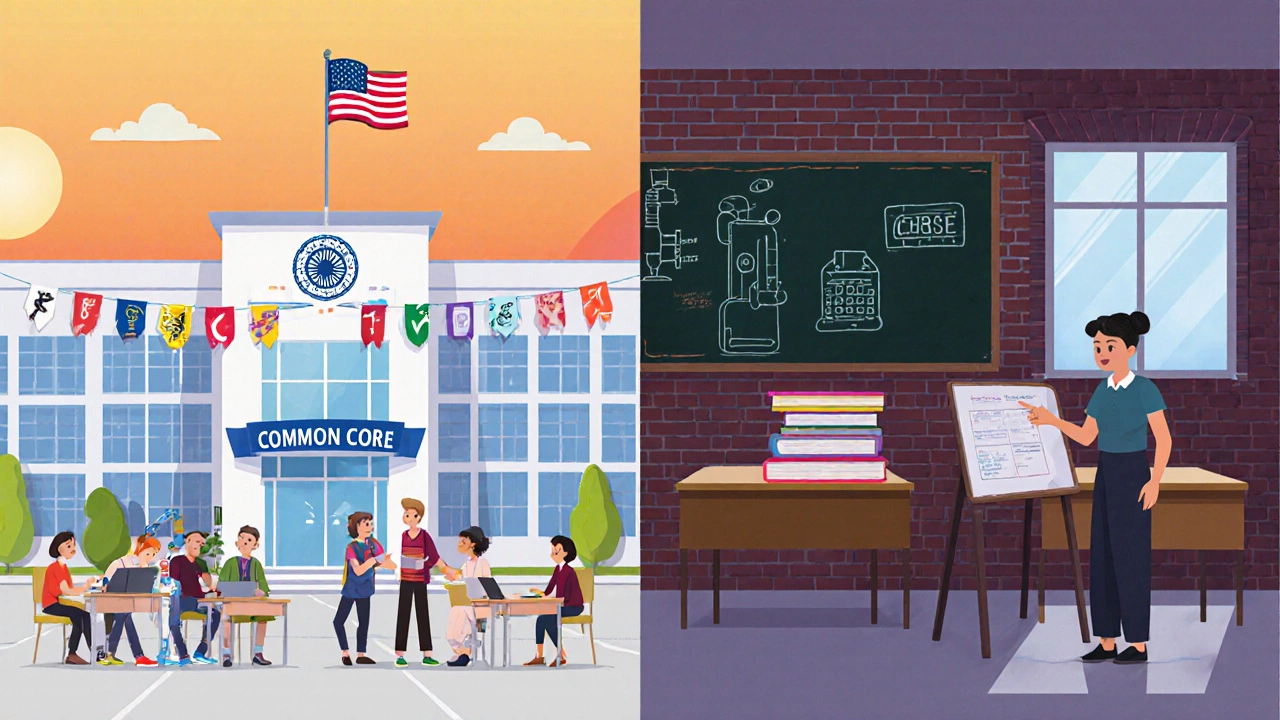
American syllabus vs CBSE: Which is easier?
Compare the American syllabus with CBSE: curriculum focus, assessments, flexibility, workload and which one feels easier for students.