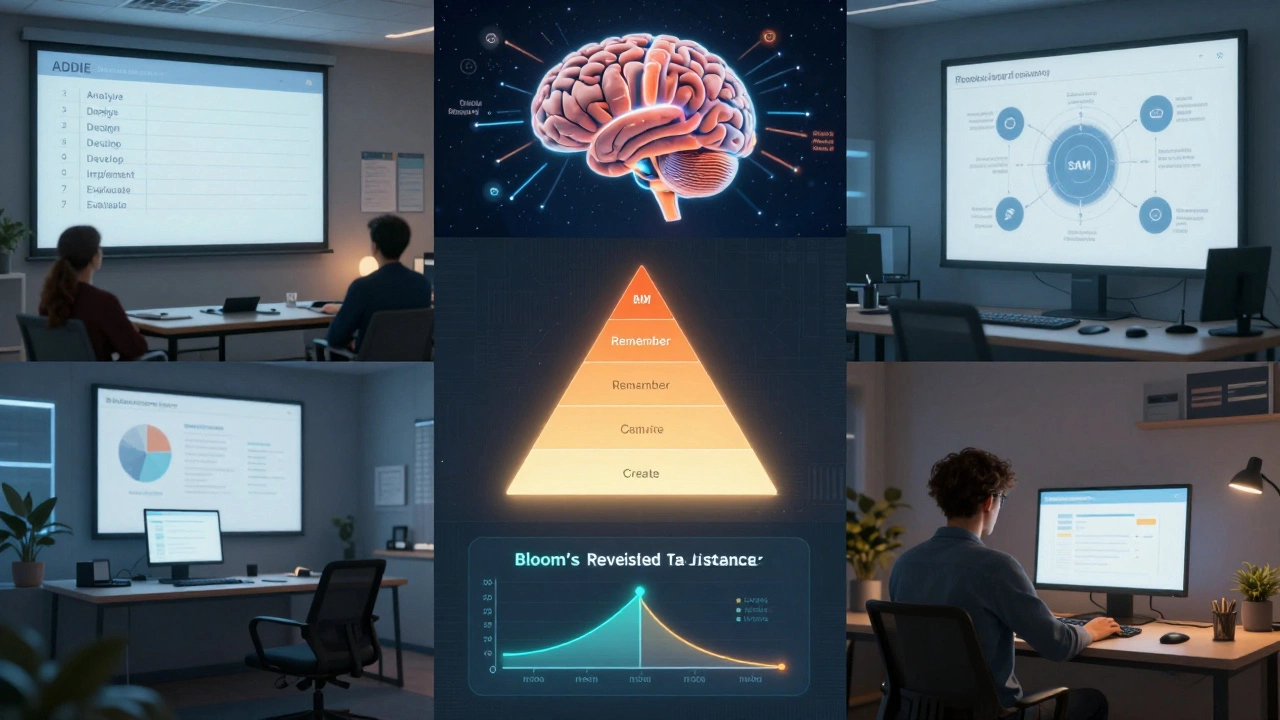
When you sign up for an online course, you’re not just watching videos or reading PDFs. Behind every effective eLearning experience is a carefully designed model that shapes how you learn. These models aren’t just theory-they’re the invisible architecture that determines whether you actually remember what you learned or forget it by next week.
What Exactly Is an eLearning Model?
An eLearning model is a structured approach to designing online learning. It tells educators how to organize content, what tools to use, how to engage learners, and how to measure success. Think of it like a recipe: same ingredients (videos, quizzes, forums), but different methods change the outcome.
Not all models work for everyone. A high school student learning algebra needs a different structure than a nurse updating her certification or a manager learning project management. That’s why five core models dominate the field today-and why picking the right one makes all the difference.
1. ADDIE Model
ADDIE stands for Analyze, Design, Develop, Implement, Evaluate. It’s the oldest and most widely used framework in eLearning, originally created for military training in the 1970s. Today, it’s the backbone of corporate onboarding, university online programs, and government training portals.
Here’s how it works:
- Analyze - Who are the learners? What do they need to know? What’s their tech access like?
- Design - Map out learning objectives, structure modules, choose assessments.
- Develop - Build the actual content: videos, slides, interactive simulations.
- Implement - Launch the course and deliver it to learners.
- Evaluate - Gather feedback, check test scores, fix what’s broken.
ADDIE is reliable but slow. If you’re updating a compliance course every year, it works fine. But if you’re launching a fast-moving product training for remote sales teams, waiting months to evaluate can mean your content is already outdated.
2. SAM Model (Successive Approximation Model)
SAM was built to fix ADDIE’s biggest flaw: it’s too linear. SAM, developed by Michael Allen, uses rapid prototyping. Instead of waiting until everything is perfect, you build a rough version early, test it with real users, and improve it in cycles.
Here’s the flow:
- Preparation - Gather requirements and set goals.
- Iterative Design - Create a quick prototype (even just a wireframe or mockup).
- Testing - Get feedback from 5-10 learners. What confused them? What felt boring?
- Revise - Fix the issues, then repeat until it works.
SAM is perfect for startups, tech companies, and any team that needs to move fast. For example, a SaaS company training new hires on their app might use SAM: build a clickable demo in two days, let five employees try it, fix the confusing buttons, and launch in a week. No six-month planning cycle.
3. Bloom’s Taxonomy (Revised)
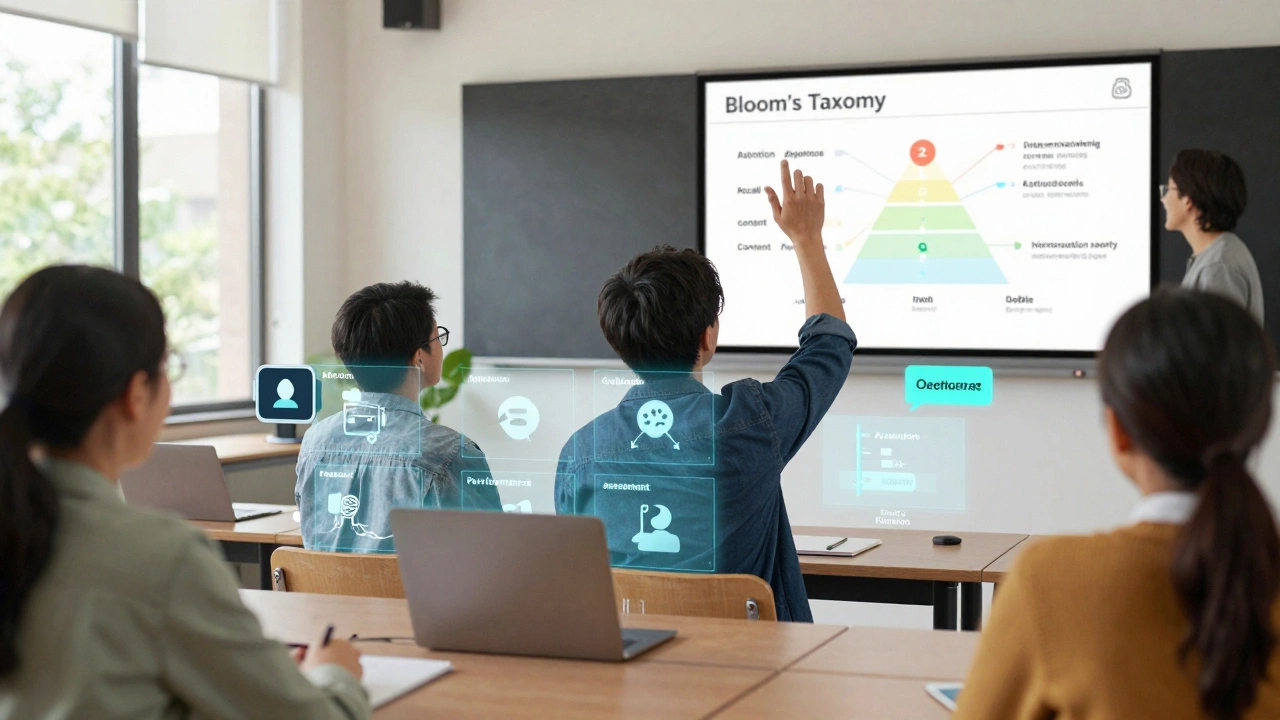
Bloom’s isn’t just for teachers-it’s the secret sauce behind effective learning outcomes. The original version from 1956 ranked cognitive skills from simple recall to complex creation. The 2001 revision updated the language and order to better fit modern learning.
The six levels, from lowest to highest:
- Remember - Recall facts (e.g., “What’s the capital of Australia?”)
- Understand - Explain ideas (e.g., “Describe how a firewall works”)
- Apply - Use knowledge in new situations (e.g., “Calculate your monthly budget using this template”)
- Analyze - Break down information (e.g., “Compare two marketing strategies”)
- Evaluate - Make judgments (e.g., “Which approach is more ethical?”)
- Create - Build something new (e.g., “Design your own mobile app wireframe”)
High-quality eLearning doesn’t just ask learners to memorize. It pushes them to create, evaluate, and apply. A course on financial literacy that only quizzes users on interest rates? That’s Remember level. A course that asks them to simulate a loan payoff plan using real numbers? That’s Apply and Create. The difference? Retention jumps from 20% to over 75%.
4. Gagne’s Nine Events of Instruction
Robert Gagne’s model is like a checklist for human attention. It’s based on decades of cognitive psychology research. If you’ve ever taken an online course that started with a quick question, used a story, gave you a summary, and ended with a quiz-you’ve experienced Gagne’s model in action.
The nine steps:
- Gain attention - Start with a surprising fact or question. “Did you know 80% of people forget what they learned in training within 48 hours?”
- Inform learners of objectives - “By the end of this module, you’ll be able to file your taxes using this software.”
- Stimulate recall of prior learning - “Remember how we did this in the last course?”
- Present the content - Deliver the lesson using text, video, or simulation.
- Provide learning guidance - Offer examples, analogies, or step-by-step walkthroughs.
- Elicit performance - Ask learners to do something: answer a question, drag and drop, record a response.
- Provide feedback - Tell them if they got it right or wrong, and why.
- Assess performance - A quiz, project, or simulation to measure mastery.
- Enhance retention and transfer - Give them a cheat sheet, job aid, or real-world challenge to apply it later.
This model is why some courses stick and others don’t. It’s not about fancy graphics-it’s about triggering memory, engagement, and application at every stage.
5. Moore’s Theory of Transactional Distance
This one’s less about content and more about psychology. Developed by Michael Moore in the 1980s, it explains why some online learners drop out-not because the material is hard, but because they feel disconnected.
Transactional distance is the gap between the learner and the instructor. It’s made up of three things:
- Structure - How rigid is the course? Fixed deadlines? No flexibility?
- Dialogue - Can learners ask questions? Get feedback? Talk to others?
- Autonomy - Can learners choose their pace, path, or project?
The more structure you add, the less dialogue and autonomy you can have-and vice versa. A highly structured course (like a certification prep with weekly deadlines) needs more dialogue to keep learners engaged. A self-paced course (like a Udemy class) needs better tools for autonomy, like progress trackers or community forums.
Think of it this way: If you’re taking a course alone at 2 a.m. with no one to ask, even the best content feels lonely. That’s transactional distance. The best eLearning platforms fix this with live Q&As, peer review systems, and chatbots that answer common questions instantly.
Which Model Should You Use?
There’s no single “best” model. It depends on your learners and goals.
Use ADDIE if you’re building a long-term, compliance-heavy course (like healthcare safety or financial regulations).
Use SAM if you’re in a fast-moving industry (tech, marketing, startups).
Use Bloom’s to make sure your course pushes learners beyond memorization.
Use Gagne’s to design any course that needs to stick-especially for adults with short attention spans.
Use Moore’s to prevent dropouts in self-paced or remote learning environments.
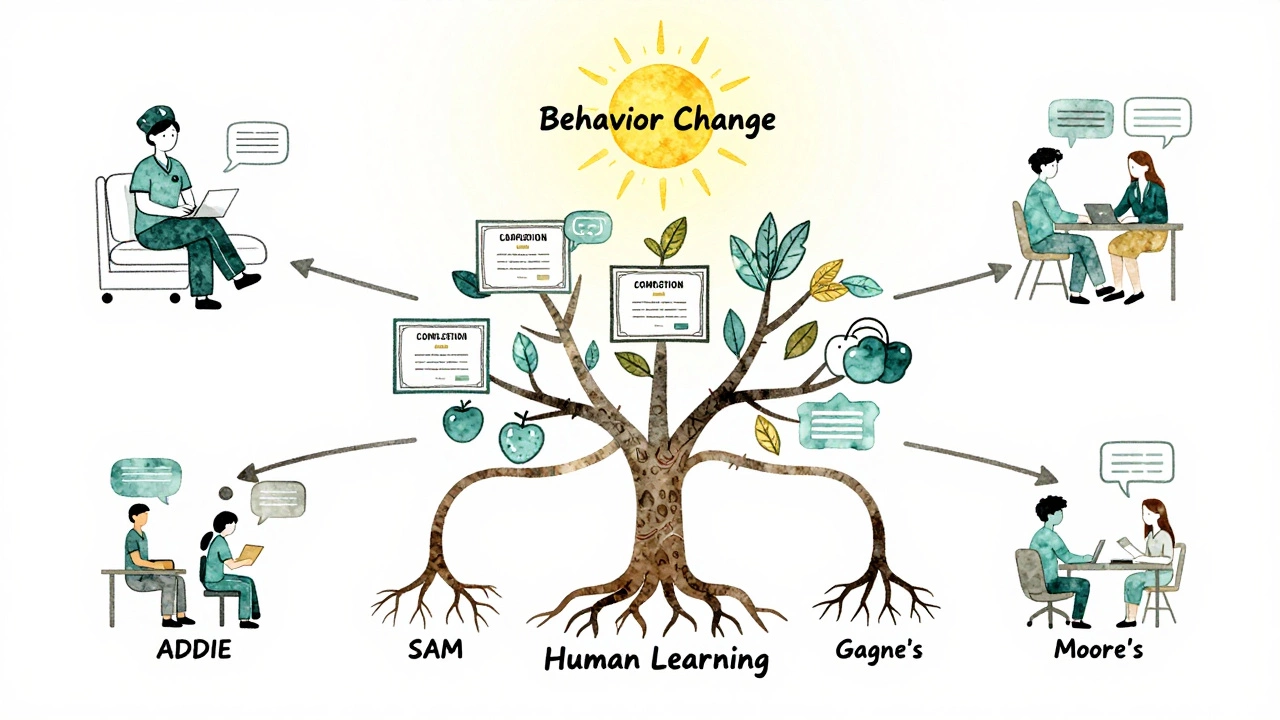
Many top platforms blend them. For example, Coursera uses ADDIE to design courses, SAM to update them yearly, Bloom’s to build assessments, Gagne’s to keep learners engaged, and Moore’s to add discussion boards and peer feedback.
What Happens When You Ignore These Models?
Companies waste millions building courses that don’t work. A 2023 study by the Association for Talent Development found that 70% of corporate eLearning programs fail to improve job performance. Why? They treated learning like a PowerPoint slideshow-dump content, hit publish, and hope for the best.
Without a model, you get:
- Learners who finish the course but can’t apply anything
- High dropout rates because learners feel lost
- Training that doesn’t meet compliance or certification standards
- Wasted budget on content that nobody remembers
The fix isn’t more videos. It’s better design.
Final Thought: Design for Humans, Not Systems
eLearning isn’t about technology. It’s about how people learn. The best models don’t care if you’re using Moodle, Canvas, or a custom app. They care if the learner feels supported, challenged, and clear about what to do next.
Ask yourself: Did your last online course make you feel smarter-or just tired? If it was the latter, it probably skipped one of these five models. Fix that, and you’ll see real results-not just completion rates, but real change in how people work, think, and solve problems.
What are the five most common eLearning models?
The five most common eLearning models are ADDIE, SAM (Successive Approximation Model), Bloom’s Revised Taxonomy, Gagne’s Nine Events of Instruction, and Moore’s Theory of Transactional Distance. Each serves a different purpose: ADDIE for structured development, SAM for fast iteration, Bloom’s for cognitive depth, Gagne’s for engagement, and Moore’s for reducing learner isolation.
Which eLearning model is best for corporate training?
ADDIE is still the most common choice for corporate training because it’s systematic and audit-friendly. But for faster updates-like software onboarding or compliance changes-SAM works better. Pair either with Bloom’s Taxonomy to ensure learners aren’t just memorizing policies but applying them in real scenarios.
Can I use more than one eLearning model at the same time?
Yes, and most effective courses do. For example, you might use ADDIE to plan the overall course, SAM to test modules early, Bloom’s to design assessments, Gagne’s to structure each lesson, and Moore’s to add discussion forums. Combining models creates a more responsive, engaging, and lasting learning experience.
Why do so many online courses fail?
Most fail because they focus on delivering content instead of designing learning. They skip evaluation, ignore learner psychology, and don’t build in feedback loops. Without Gagne’s events or Moore’s focus on connection, learners disengage. Without Bloom’s higher-order tasks, they forget everything within days.
How do I know if my eLearning course is working?
Look beyond completion rates. Ask: Can learners apply what they learned on the job? Do they solve problems they couldn’t before? Are they recommending the course to others? Use Bloom’s levels to design real-world tasks, and use Moore’s model to track engagement through forums or live sessions. Real success is behavior change, not just clicks.