
Career Path Recommender
Find Your Best Path
Answer these quick questions to get a personalized recommendation for the best job-ready course in 2025.
How This Works
Based on your answers, we'll match you with the best job-ready course in 2025. Each recommendation is backed by 2025 hiring data from Australian companies like Atlassian and Canva.
Your Recommendation
Want to know the best course to get a job? It’s not about picking the most popular one. It’s not about what your friend took. It’s about what employers are actually hiring for right now-and what skills are still in short supply. The answer changes every year. In 2025, the game has shifted again.
Jobs aren’t going to the degree holders anymore
Five years ago, a bachelor’s degree was your golden ticket. Today, it’s just the entry fee. Employers don’t care if you went to a top university if you can’t fix a broken API, run a Google Ads campaign, or write a Python script that pulls data from a spreadsheet. They care about what you can do on day one.
Look at the data. LinkedIn’s 2025 Workforce Report shows that 78% of hiring managers in Australia prioritize skills over degrees for entry-level roles. That’s up from 52% in 2020. Companies like Atlassian, Canva, and even big banks are dropping degree requirements for tech and digital roles. They’re testing skills instead.
So if you’re asking, "What’s the best course?"-you’re asking the wrong question. The real question is: "What skill will get me hired fastest?" And the answer depends on your starting point, your location, and your goals.
Top 3 job-ready courses in 2025
Not all courses are created equal. Some teach theory. Others teach you how to build something real. Here are the three courses that actually lead to jobs right now, backed by hiring trends from Australian job boards like Seek, Indeed, and LinkedIn.
- Certified Google Data Analytics Professional Certificate (on Coursera): This isn’t just a course. It’s a portfolio builder. You learn SQL, Tableau, R, and how to clean messy data-all through real-world case studies. Over 1,200 Australian companies listed "Google Data Analytics" as a preferred qualification in 2025. Graduates land roles as junior analysts, business intelligence associates, or operations coordinators. Median starting salary: $62,000.
- Full Stack Web Development (freeCodeCamp or Udacity Nanodegree): You don’t need a computer science degree to build websites that companies pay for. This course teaches HTML, CSS, JavaScript, React, Node.js, and MongoDB. You build five real projects and deploy them. In 2025, 63% of Australian startups hired junior developers from bootcamp grads-no degree required. The average time to hire: 18 days after completing the course.
- Amazon Web Services (AWS) Certified Cloud Practitioner: Every business is moving to the cloud. That means cloud support roles are exploding. This course takes 4-6 weeks. You learn how AWS works, how to secure cloud environments, and how to estimate costs. Over 800 job postings in Australia in 2025 asked for AWS certification. Many of them didn’t even require prior experience. Just the cert.
These aren’t "maybe" options. They’re proven paths. Each one gives you a certificate, a portfolio, and a way to prove your skills-no resume fluff.
What courses to avoid
Not every online course is worth your time. Some are just expensive theory with no job link.
Avoid courses that:
- Only teach "soft skills" like leadership or communication without a technical skill attached
- Require you to pay $2,000+ without offering hands-on projects or mentorship
- Promise "guaranteed job placement" but don’t show names of companies they’ve placed people in
- Focus on outdated tools like Flash, PHP 5, or Excel macros for complex reporting
For example, a $1,500 "Digital Marketing Masterclass" that only covers Facebook Ads in 2023 is useless now. TikTok Ads, Google Performance Max, and AI-driven ad optimization are the new standard. If the course doesn’t mention these, walk away.

How to pick the right course for you
You don’t need to copy someone else’s path. The best course is the one that matches your life.
Ask yourself:
- What do I enjoy doing? (Do you like solving puzzles? Data? Talking to people? Building things?)
- What’s my budget? (Can you spend $50 or do you need free options?)
- How much time can I commit per week? (2 hours? 10 hours?)
- Where do I want to work? (Remote? Office? Freelance?)
Here’s a quick guide:
| Your Situation | Best Course Option | Time to Job |
|---|---|---|
| Have no tech background, want a stable job | Google Data Analytics | 3-5 months |
| Like building things, good at logic | Full Stack Web Development | 4-6 months |
| Work in admin, sales, or customer service | AWS Cloud Practitioner | 2-4 months |
| On a tight budget, can study 10+ hours/week | freeCodeCamp (free) | 6-8 months |
| Already have a degree but stuck in a dead-end job | Google IT Support Professional Certificate | 2-3 months |
Don’t wait for the "perfect" course. Start with one that fits your life. Finish it. Build something. Then move to the next.
Why certificates matter more than you think
Here’s the truth: employers don’t care if you watched 100 videos. They care if you can show them a live website, a cleaned dataset, or a cloud setup you built.
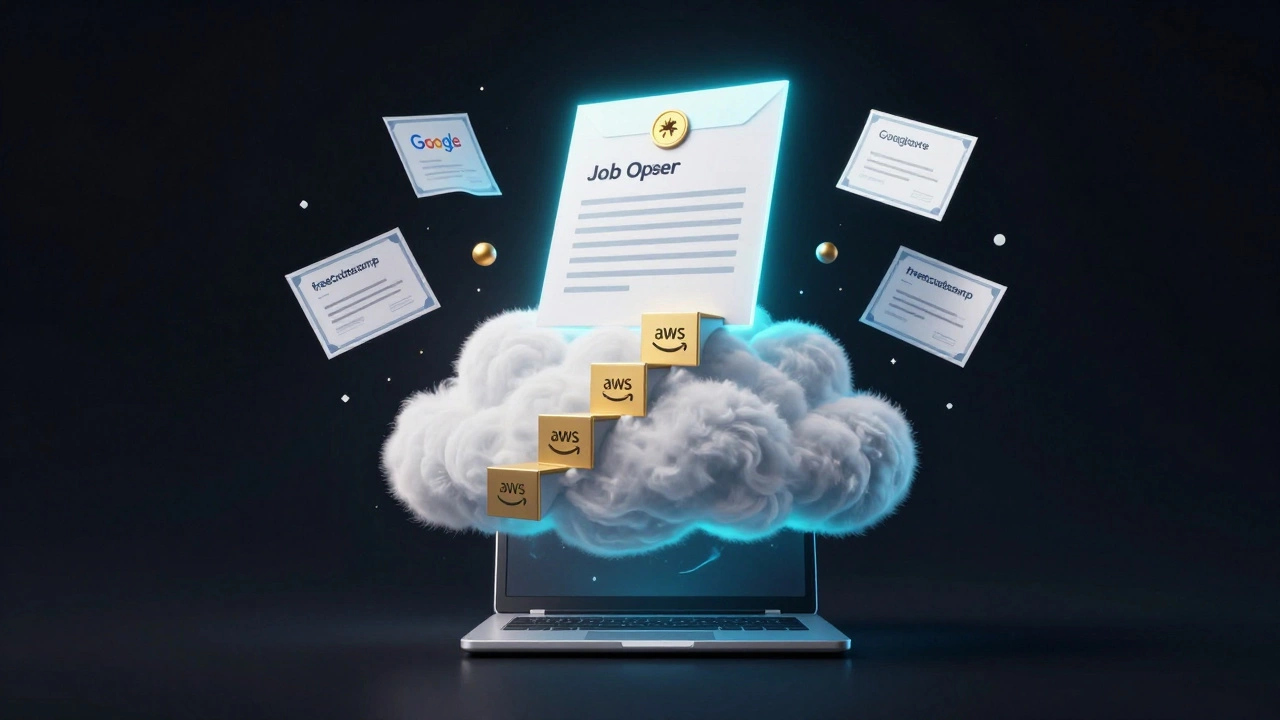
Certificates from Google, AWS, Microsoft, and freeCodeCamp act like a resume filter. They tell hiring managers: "This person didn’t just learn-they did." That’s why 82% of Australian recruiters say they prioritize applicants with industry-recognized certifications over those with only degrees.
And here’s the kicker: many of these certifications are free or under $100. The AWS exam is $100. Google’s data analytics cert is $49/month (you can finish in 3 months). freeCodeCamp? Zero cost.
Don’t let cost stop you. The real cost is not starting.
What to do after you finish the course
Finishing the course is only half the battle. The next step is proving you can do the job.
Do this:
- Build a simple portfolio website (even if it’s just one page with your projects)
- Upload your projects to GitHub or a free hosting site
- Write a short LinkedIn post: "Just finished my Google Data Analytics cert. Here’s what I built: [link]"
- Apply to 5 entry-level jobs a week. Don’t wait until you "feel ready."
- Ask for feedback. Send your portfolio to someone in the field and say: "Can you tell me what’s missing?"
People who get hired after these courses aren’t the smartest. They’re the ones who shipped something and kept going.
Real stories from real people
In Adelaide, a 32-year-old retail worker took the Google Data Analytics course while working nights. She finished in four months. She built a dashboard showing customer purchase patterns for a local café. She posted it on LinkedIn. A marketing agency reached out. She got hired as a junior analyst at $65,000 a year.
In Brisbane, a 19-year-old dropped out of uni. He spent six months on freeCodeCamp. Built a booking site for a local surf school. Applied to 12 small tech firms. Got hired as a front-end dev at $58,000.
These aren’t outliers. They’re normal people who chose a path and stuck to it.
Start now. Don’t wait for the perfect time.
The best course to get a job isn’t the one with the fanciest website or the most ads. It’s the one you start today.
You don’t need to quit your job. You don’t need to borrow money. You don’t need to wait for a better economy. You just need to pick one course. Do the first lesson. Build one thing. Then keep going.
2025 isn’t waiting for you to feel ready. It’s waiting for you to start.
Is it possible to get a job with just an online course and no degree?
Yes, absolutely. In 2025, over 60% of entry-level tech and digital roles in Australia don’t require a degree. Employers are focused on skills you can prove-like building a website, analyzing data, or managing cloud systems. Certifications from Google, AWS, and freeCodeCamp carry real weight with hiring managers. What matters is what you can do, not what diploma you hold.
How long does it take to get a job after completing an online course?
Most people land a job within 2 to 6 months after finishing a hands-on course, depending on how much time they can commit. If you study 10-15 hours a week and build a portfolio, you can be job-ready in 3-4 months. The key isn’t speed-it’s consistency. People who apply to jobs while still learning get hired faster than those who wait until they "know everything."
Are free online courses worth it?
Yes, if they include projects and certifications. freeCodeCamp, Google’s Coursera courses (financial aid available), and Microsoft Learn offer free, high-quality training that leads directly to jobs. The paid versions often just give you a certificate. The real value is in the projects you build. Many people have landed jobs using only free resources.
What if I’m not good at tech or math?
You don’t need to be a math genius. Many job-ready courses focus on tools, not theory. For example, Google Data Analytics teaches you how to use Excel, SQL, and Tableau-point-and-click tools that don’t require coding. You learn by doing real tasks, like cleaning sales data or making charts. If you can follow step-by-step instructions, you can learn these skills. Many people who struggled in school thrive in these courses because they’re practical, not academic.
Should I take multiple courses at once?
No. Spreading yourself thin slows you down. Focus on one course until you finish it and build at least one project. Then move to the next. People who jump between courses never finish anything. Employers care about depth, not breadth. One completed project with a certificate is worth ten unfinished courses.