
IMO Problem Difficulty Estimator
Estimate how difficult an International Mathematical Olympiad (IMO) problem is. Based on the problem's complexity, creativity required, and historical solving rates, we'll show you the actual difficulty rating.
Sample Problem
Problem 2 from the 2021 IMO: “Prove that for any positive integer n, the number of ways to write n as a sum of consecutive positive integers equals the number of odd divisors of n.”
How difficult is this problem?
Rate this problem on a scale of 1-10 (1 = easiest, 10 = hardest)
When people ask about the most prestigious math exam in the world, they’re not talking about standardized tests like the SAT or GRE. They’re not asking about college entrance exams or national curriculum assessments. They’re asking about the one contest that顶尖 math students from over 100 countries train for years to enter - the International Mathematical Olympiad (an annual global competition for high school students, founded in 1959, where participants solve problems requiring deep creativity and proof-based reasoning).
Why the IMO Stands Above All Others
The IMO isn’t just another math contest. It’s the Olympic Games of mathematics. No other exam combines such intense selection pressure, global participation, and historical prestige. Countries spend months preparing teams through national olympiads, training camps, and private tutoring. The top scorers often go on to become Fields Medalists, professors at MIT or Cambridge, or researchers at Google DeepMind.
What makes it different? Most exams test how well you remember formulas or apply standard methods. The IMO tests how well you can solve problems that don’t have a textbook solution. You won’t find a single multiple-choice question. Every problem demands a rigorous, original proof. The six problems - two per day over two days - cover algebra, combinatorics, geometry, and number theory. Each is designed to stump even university math majors.
The Selection Process: How Students Get There
Getting to the IMO isn’t a matter of signing up online. It’s a multi-year ladder. In the U.S., students start with the AMC 10/12, then qualify for the AIME, then the USA(J)MO, and finally the Mathematical Olympiad Summer Program. In China, students go through provincial olympiads, national selections, and intensive training at specialized schools. In Russia, the tradition goes back decades - entire families have produced IMO medalists.
Each country selects six students. That’s it. No more. No exceptions. The selection rate is often less than 0.01% of all high school students in a country. In 2024, over 600 students competed at the IMO, but they came from a pool of more than 10 million secondary students worldwide.
What Winning Looks Like
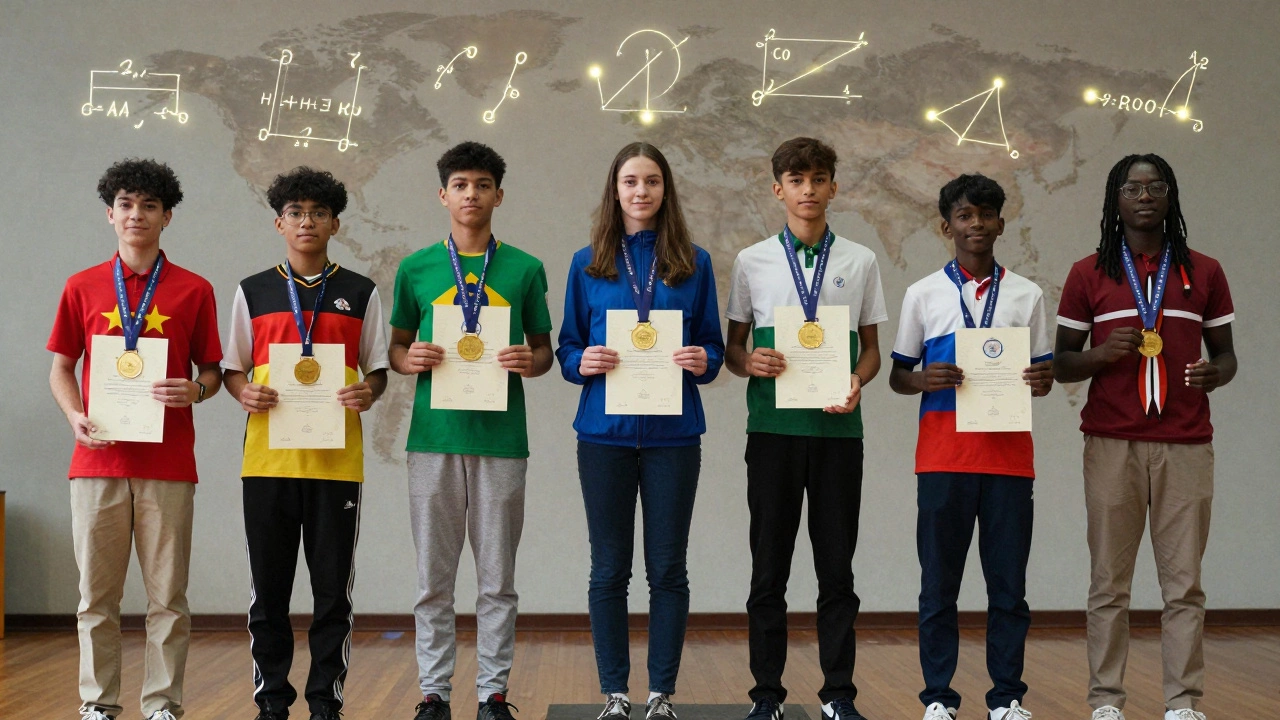
Medals are awarded based on cutoff scores. In recent years, the gold medal threshold has hovered around 30 out of 42 possible points. A perfect score - solving all six problems with flawless proofs - happens fewer than five times per decade. Only 11 students in history have achieved a perfect score more than once. The most decorated participant ever is Zhuo Qun (Alex) Song from Canada, who earned five gold medals and one bronze between 2010 and 2015.
But medals aren’t the whole story. The real prestige lies in the problems themselves. Take 2021’s Problem 2: “Prove that for any positive integer n, the number of ways to write n as a sum of consecutive positive integers equals the number of odd divisors of n.” That’s not something you study in school. It’s something you discover by playing with patterns, testing small cases, and building insight from scratch.
Who Runs the IMO?
The IMO is organized by a rotating host country each year, under the supervision of the International Mathematical Union (the global body representing mathematicians, founded in 1920, which also awards the Fields Medal). The problems are proposed by mathematicians from around the world, then carefully reviewed and selected by an international jury. The jury includes professors from top universities - Harvard, Oxford, ETH Zurich, Tsinghua - who volunteer their time because they believe in nurturing raw mathematical talent.
There’s no registration fee. No corporate sponsors. No advertising. The event is funded by governments and universities. That purity matters. The IMO has never been commercialized. It’s not about rankings or rankings apps. It’s about the beauty of pure mathematics.
How It Compares to Other Math Competitions
There are other notable contests - the Putnam Competition for undergraduates, the UKMT challenges, the Asian Pacific Mathematical Olympiad. But none match the IMO’s scope or history.
| Competition | Level | Participants | Problem Type | Global Recognition |
|---|---|---|---|---|
| International Mathematical Olympiad (IMO) | High School | 600+ | Proof-based, open-ended | Extremely High |
| William Lowell Putnam | Undergraduate | 5,000+ | Proof-based | High in North America |
| Asian Pacific Mathematical Olympiad | High School | 300+ | Proof-based | Regional |
| USA Mathematical Olympiad (USAMO) | High School | 500 | Proof-based | High in U.S. |
| AMC 12 | High School | 300,000+ | Multiple choice, short answer | Low |
The Putnam is harder in some ways - the problems are more abstract, the time pressure greater. But it’s limited to North America. The IMO is the only one where a 16-year-old from Vietnam can stand on stage next to a 17-year-old from Germany and receive the same medal for the same solution.
The Ripple Effect: What Happens After the IMO
Winning a medal at the IMO doesn’t just look good on a resume. It changes your life. Many medalists receive full scholarships to top universities before they even graduate high school. Some are offered research positions at institutions like the Institute for Advanced Study. Others are invited to work with mathematicians on unsolved problems.
Take Terence Tao. He won a gold medal at the IMO at age 13. Today, he’s a Fields Medalist and professor at UCLA. He credits the IMO for teaching him how to think mathematically - not just solve problems, but see patterns others miss.
It’s not just about becoming a mathematician. Former IMO participants now lead AI labs, build quantum algorithms, design financial models, and solve cryptography challenges. The skills - persistence, abstraction, logical rigor - translate directly into tech, finance, and science.

Can You Prepare for It?
Yes - but not like a normal exam. You can’t cram formulas. You can’t memorize solutions. You need to build intuition. The best preparation involves:
- Solving past IMO problems (available on the official website)
- Studying problem-solving books like The Art and Craft of Problem Solving by Paul Zeitz
- Joining online communities like Art of Problem Solving (AoPS)
- Working with mentors who’ve competed before
- Practicing writing full proofs - not just answers
Most students who win medals have spent 2-4 years training seriously. It’s not about being a genius. It’s about being stubborn. About loving the struggle of a problem that takes three days to crack.
Final Thoughts: Why It Still Matters
In a world obsessed with AI, automation, and speed, the IMO is a rare space where human creativity still rules. No algorithm can solve an IMO problem the way a 17-year-old can - with insight, intuition, and a quiet, stubborn focus.
The most prestigious math exam isn’t prestigious because of its difficulty. It’s prestigious because it reveals something deeper: the human capacity to find order in chaos, beauty in complexity, and truth in silence.
Is the IMO the hardest math exam in the world?
Yes, in terms of difficulty and prestige combined. While other exams like the Putnam or the Chinese Mathematical Olympiad are extremely challenging, the IMO is unique because it brings together the top students from every continent, using problems designed by world-class mathematicians. It’s not just hard - it’s designed to separate those who can think beyond textbooks.
Can you take the IMO more than once?
Yes, but only if you’re still in high school and haven’t turned 20 before the contest date. Most students compete once or twice. The maximum number of times someone can compete is six - once per year from age 13 to 18. Only a handful have competed six times.
Do you need to be a math prodigy to compete?
Not necessarily. Many medalists weren’t the top students in their school. They were the ones who spent hours every day working on problems, reading books, and discussing solutions with peers. Talent helps, but persistence and curiosity matter more. The IMO rewards those who enjoy the process, not just the result.
Are there prizes or scholarships for winning the IMO?
There are no cash prizes from the IMO itself. But winning a medal often leads to full scholarships at top universities, invitations to research programs, and opportunities to work with leading mathematicians. Some countries offer national scholarships or cash awards to medalists. In China, top performers may be fast-tracked into elite university programs without entrance exams.
Is the IMO only for students from wealthy countries?
No. Countries like Vietnam, Romania, Iran, and Bulgaria have consistently produced top performers despite limited resources. The problems are language-neutral - they rely on logic, not vocabulary. Many training programs are free and run by volunteers. The IMO is one of the few global competitions where socioeconomic background matters less than passion and discipline.
What’s Next for IMO Winners?
After the IMO, many students don’t stop. They move on to research, internships, or advanced math circles. Some become problem writers for future Olympiads. Others start YouTube channels or blogs to help younger students. The community stays connected - alumni networks span continents.
If you’re serious about math, the IMO isn’t just a goal. It’s a doorway. And the people who walk through it don’t just solve equations - they change how we think about them.