JEE Chemistry Strength Analyzer
Your Chemistry Learning Profile
Based on your responses, here's your personalized analysis
Branch Proficiency Analysis
Your Strongest Branch
Your Area of Improvement
Personalized Study Strategy
Recommended Time Allocation
There is no single "hardest" chapter in JEE Chemistry is a core subject in the Joint Entrance Examination that tests conceptual depth, calculation speed, and factual recall across three distinct branches. If you ask ten toppers, you’ll get ten different answers. Some swear by Organic Chemistry is the branch dealing with carbon-based compounds, reaction mechanisms, and stereochemistry. because it feels like a foreign language. Others panic at Physical Chemistry is the application of physics principles to chemical systems, involving thermodynamics, kinetics, and quantum mechanics. because the math gets heavy. And then there are those who dread Inorganic Chemistry is the study of non-carbon compounds, focusing on periodic trends, coordination chemistry, and named reactions. due to the sheer volume of facts to memorize.
The truth is, difficulty is subjective. It depends entirely on your strengths. Are you good at logic and patterns? Organic might be your playground. Do you love solving complex equations? Physical will feel natural. Can you retain detailed information quickly? Inorganic could be your high-scoring zone. However, based on data from coaching institutes and student feedback over the years, certain chapters consistently rank as the most challenging. Let’s break down why specific topics in each branch give students trouble and how to tackle them effectively.
Why Organic Chemistry Feels Like the Boss Level
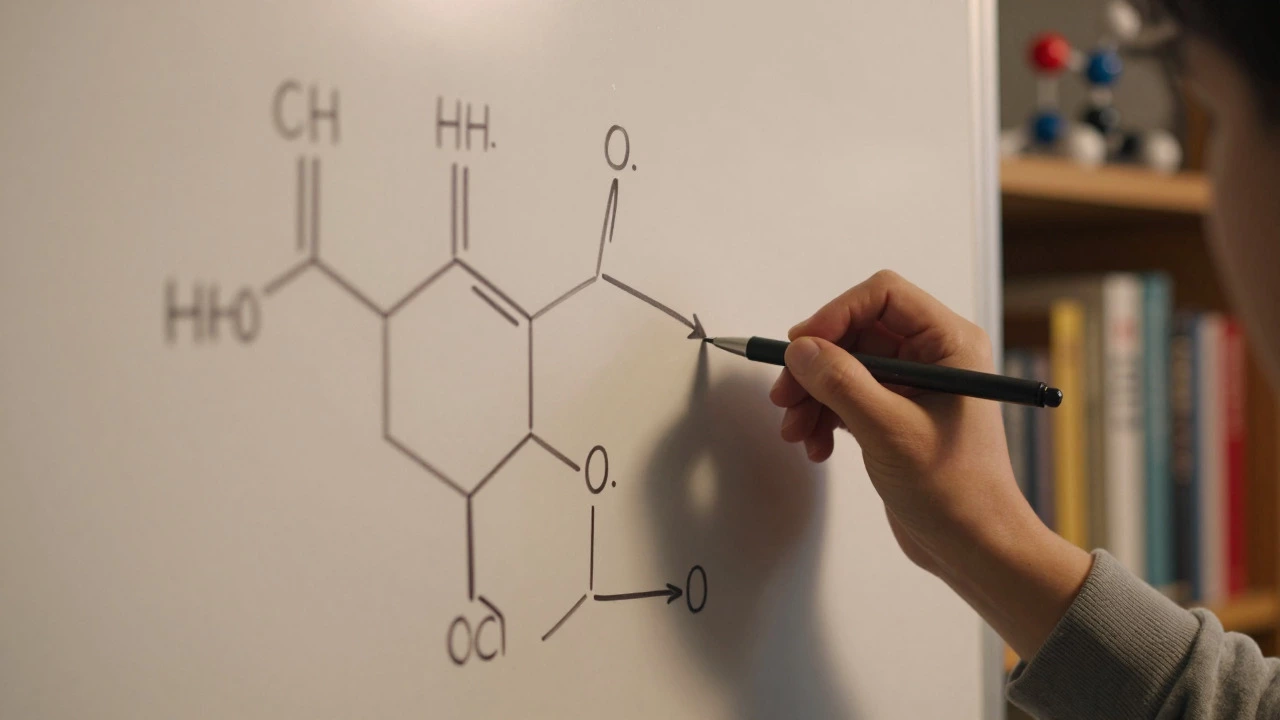
For many students, Organic Chemistry is where they hit a wall. Unlike Physics, where you apply formulas, or Inorganic, where you memorize facts, Organic requires you to understand why electrons move the way they do. It’s less about rote learning and more about visualizing invisible processes.
The biggest hurdle here is Reaction Mechanisms are step-by-step descriptions of how chemical bonds break and form during a reaction.. You can’t just memorize that reactant A turns into product B. You need to know the intermediate steps, the role of nucleophiles and electrophiles, and how steric hindrance affects the outcome. If your foundation in basic concepts like hybridization, resonance, and inductive effects is weak, everything else collapses.
Specifically, these sub-topics tend to trip people up:
- Stereochemistry: Understanding chirality, R/S configuration, and optical activity requires strong 3D visualization skills. If you can’t rotate molecules in your head, this becomes a nightmare.
- Biomolecules and Polymers: While often considered easier, the intricate structures of carbohydrates, amino acids, and proteins require precise recall. One wrong bond direction can cost you marks.
- Aldehydes, Ketones, and Carboxylic Acids: This chapter is dense with reactions. The number of named reactions (like Aldol condensation, Cannizzaro reaction) and their specific conditions can overwhelm students who try to memorize without understanding the underlying mechanism.
The key to conquering Organic isn’t reading the textbook five times. It’s drawing. Draw every mechanism. Understand the electron flow. Once you see the pattern, Organic stops being a memory test and starts being a logic puzzle.
Physical Chemistry: Where Math Meets Molecules
If Organic is about logic, Physical Chemistry is about precision. This branch is notorious for its lengthy calculations and abstract concepts. Students who struggle with mathematics often find Physical Chemistry intimidating. But here’s the secret: if you’re good at math, this section is actually the easiest to score perfectly in because the answers are objective. There’s no ambiguity.
The most feared chapters in Physical Chemistry include:
- Chemical Kinetics: This involves differential equations and integrated rate laws. Deriving half-life formulas and understanding order of reactions can be tricky if you don’t have a solid grasp of calculus basics. The concepts of activation energy and Arrhenius equation also require careful interpretation of graphs.
- Electrochemistry: With Nernst equation, conductivity calculations, and Faraday’s laws, this chapter demands attention to detail. Sign errors and unit conversions are common pitfalls. Understanding the relationship between Gibbs free energy and cell potential is crucial for solving complex problems.
- Thermodynamics: Concepts like entropy, enthalpy, and Gibbs free energy are abstract. Distinguishing between system and surroundings, reversible and irreversible processes, and applying Hess’s law correctly requires deep conceptual clarity. Many students confuse ΔH and ΔU, leading to incorrect answers.
- Solutions: Colligative properties involve multiple formulas and assumptions. Calculating relative lowering of vapor pressure, boiling point elevation, and freezing point depression requires careful handling of mole fractions and van't Hoff factors.
To master Physical Chemistry, practice is non-negotiable. Solve numerical problems daily. Focus on dimensional analysis to catch silly mistakes. Don’t skip derivations; understanding how formulas are derived helps you remember them better and apply them in unfamiliar contexts.
Inorganic Chemistry: The Memory Marathon
Inorganic Chemistry is unique. It doesn’t require heavy math or complex logic chains. Instead, it demands consistent revision and smart memorization techniques. The challenge isn’t understanding; it’s retaining. The syllabus is vast, covering everything from atomic structure to environmental chemistry.
Students often cite these areas as particularly tough:
- Coordination Compounds: Naming complexes using IUPAC rules, determining geometry, magnetic behavior, and stability constants can be confusing. Isomerism in coordination compounds adds another layer of complexity.
- p-Block Elements: The anomalies in group trends, especially for the first element of each group, require specific memorization. Reactions of oxides, halides, and oxyacids are numerous and often exception-heavy.
- d- and f-Block Elements: Electronic configurations, oxidation states, color, and magnetic properties of transition metals and lanthanides/actinides need systematic study. The lanthanide contraction and its consequences are frequently tested.
- Chemistry in Everyday Life: While seemingly easy, this chapter contains many drug names, functions, and classifications that are easy to mix up if not reviewed regularly.
The strategy for Inorganic is different. Use mnemonics, flashcards, and flowcharts. Create summary sheets for each chapter. Revise weekly. NCERT is your bible here-most questions are directly or indirectly based on it. Don’t ignore footnotes and examples in the textbook.
Comparing the Challenges: A Quick Reference
| Branch | Primary Challenge | Key Skill Required | Common Pitfall |
|---|---|---|---|
| Organic Chemistry | Understanding mechanisms | Logical reasoning & visualization | Mixing up similar reactions |
| Physical Chemistry | Complex calculations | Mathematical proficiency & accuracy | Unit conversion errors |
| Inorganic Chemistry | Vast content volume | Memory retention & organization | Ignoring NCERT details |
How to Identify Your Personal "Toughest" Chapter
Instead of worrying about what others find difficult, focus on your own performance. Take a diagnostic test covering all three branches. Analyze your results:
- If you lose marks due to conceptual gaps in why reactions occur, prioritize Organic.
- If you make calculation errors or take too long on numericals, focus on Physical.
- If you forget facts or confuse similar elements, dedicate time to Inorganic revision.
Your weakest area is your personal toughest chapter. Address it early. Don’t let it snowball. Allocate more time to it during your study schedule. Seek help from teachers or peers if needed. Use online resources for visual explanations, especially for Organic mechanisms and Physical Chemistry derivations.
Strategic Tips for Conquering Any Tough Chapter
No matter which chapter you find hardest, these strategies apply universally:
- Start Early: Don’t leave tough topics for last. Tackle them when you have fresh energy and ample time for revision.
- Active Recall: Test yourself instead of passive reading. Close the book and write down what you remember. Then check.
- Spaced Repetition: Review material at increasing intervals. This strengthens long-term memory, especially for Inorganic Chemistry.
- Practice Previous Year Questions (PYQs): Understand how concepts are tested. PYQs reveal patterns and highlight important topics.
- Teach Someone Else: Explaining a concept forces you to clarify your own understanding. If you can teach it, you’ve mastered it.
Remember, consistency beats intensity. Studying a little bit every day is better than cramming for hours once a week. Build habits, not stress.
Is Organic Chemistry really the hardest part of JEE?
Not necessarily. While many students perceive Organic Chemistry as the hardest due to its reliance on understanding mechanisms rather than memorization, difficulty is subjective. Students strong in logical reasoning often find Organic manageable, while those weak in visualization may struggle. Physical Chemistry can be harder for students uncomfortable with math, and Inorganic poses challenges for those who dislike memorization. Assess your personal strengths to determine your true challenge.
Which chapter has the highest weightage in JEE Chemistry?
Historically, chapters like Equilibrium, Chemical Bonding, Thermodynamics, and Electrochemistry carry significant weightage. In Organic Chemistry, Aldehydes, Ketones, and Carboxylic Acids, along with Hydrocarbons, are frequently tested. In Inorganic Chemistry, Coordination Compounds and p-Block Elements are important. However, weightage can vary slightly year to year, so it's best to cover the entire syllabus comprehensively rather than guessing high-yield topics.
Can I skip Inorganic Chemistry if I find it too hard?
Skipping Inorganic Chemistry is risky. It constitutes roughly one-third of the Chemistry paper and often contains direct questions from NCERT textbooks, making it potentially the easiest section to score full marks if studied properly. Instead of skipping, adopt effective memorization techniques like mnemonics, flowcharts, and spaced repetition. Focus on NCERT thoroughly, as most questions are derived from it.
How much time should I dedicate to Chemistry daily?
Aim for at least 1.5 to 2 hours daily for Chemistry. Divide this time among the three branches: perhaps 40 minutes for Physical (problem-solving), 40 minutes for Organic (mechanism practice), and 30-40 minutes for Inorganic (revision). Consistency is key. Regular short sessions are more effective than occasional long marathons. Adjust based on your weak areas, giving extra time to tougher chapters.
Are there any shortcuts for mastering Reaction Mechanisms?
While there are no true "shortcuts," you can streamline learning by focusing on fundamental principles: electron movement from high density (nucleophile) to low density (electrophile). Master general patterns like SN1, SN2, E1, E2 mechanisms first, as they repeat across various reactions. Use arrow-pushing diagrams extensively. Group similar reactions together (e.g., all carbonyl additions) to identify common themes. Practice drawing mechanisms repeatedly until they become intuitive.