
There’s a myth that one programming language is the hardest coding language-some kind of ultimate test for programmers. If you can master it, you’re a true expert. But that’s not how it works. The hardest language isn’t the one with the most symbols or the strangest syntax. It’s the one that fights back the hardest for you.
It’s not about the language-it’s about your background
Think of learning to code like learning to drive. If you grew up around cars, a manual transmission feels natural. If you’ve never seen a stick shift, even a simple car becomes a nightmare. The same goes for programming languages.
Someone who’s spent years working with hardware might find Assembly language easy. It’s just a direct line to the machine. But for someone used to Python’s clean, readable syntax, Assembly feels like writing a letter in ancient hieroglyphs-every character matters, and one mistake crashes the whole system.
Meanwhile, a mathematician might breeze through Haskell, where functions are pure and side effects are forbidden. But a web developer used to mutating variables and async callbacks will hit a wall. Haskell doesn’t just ask you to learn new syntax-it asks you to unlearn how you think about state and change.
Assembly: the language that doesn’t forgive
Assembly language is often called the hardest because it forces you to manage everything yourself. No memory allocation helpers. No garbage collection. No error messages that say ‘you forgot a semicolon.’ You’re talking directly to the CPU, register by register.
On an x86 processor, you might need to write 20 lines of Assembly just to add two numbers and store the result. In Python, you’d write: a = b + c. In Assembly, you’re loading values into registers, checking flags, handling overflow, and managing memory addresses. One wrong move and your program crashes silently-no stack trace, no debugger help.
Real-world example: In 2023, a team at a robotics company in Adelaide spent three weeks debugging a sensor drift issue. The problem wasn’t in the algorithm-it was in a single misplaced mov instruction in their motor control firmware. They’d been writing in C, but the low-level timing code was in Assembly. One byte off, and the robot spun in circles for hours.
C++: the language that gives you a gun and a thousand bullets
C++ is the Swiss Army knife of programming languages. It’s fast. It’s powerful. And it lets you shoot yourself in the foot in over 100 different ways.
Memory management? You handle it. Pointers? You navigate them. Templates? They can generate error messages longer than your entire program. Multiple inheritance? Good luck tracing which method got called when.
Unlike Java or C#, where the compiler protects you from many mistakes, C++ trusts you. And it will not apologize when you mess up. A dangling pointer? It might work today and crash next week. A buffer overflow? It could be exploited by a hacker-or just corrupt your data quietly.
Companies like Adobe, Google, and Unreal Engine still rely on C++ because nothing else gives them that level of control. But every C++ developer has a story about a bug that took days to fix because the compiler didn’t catch it-and neither did their tests.
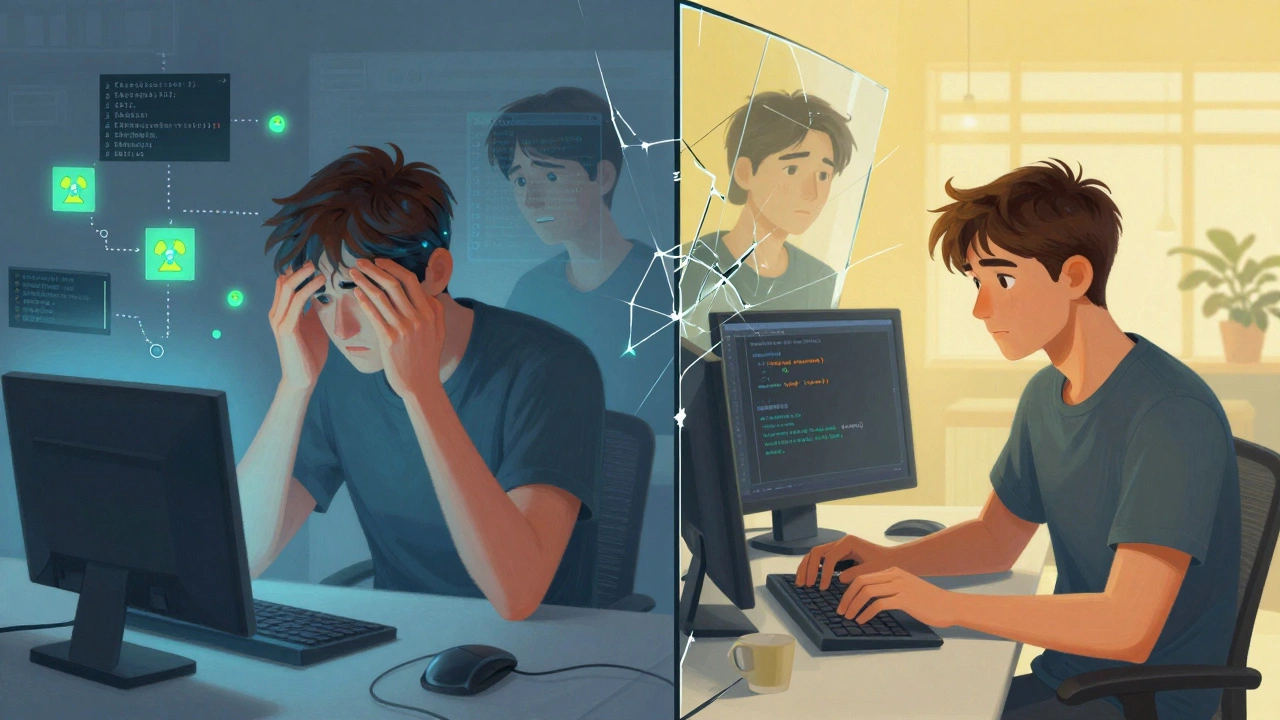
Haskell: the language that rewrites your brain
If Assembly is like building a car from scratch, and C++ is like driving a race car with no seatbelt, Haskell is like learning to ride a unicycle while solving calculus problems in your head.
Haskell is functional. That means no variables change value. No loops. No side effects. Everything is a function that takes input and returns output. If you want to add up a list of numbers, you don’t write a for-loop. You use recursion and higher-order functions like fold.
It sounds elegant. And it is-for people who think in math. But for most developers, it’s alien. You can’t just ‘update’ a counter. You have to create a new version of the state. It’s like trying to edit a PDF by making a copy, changing one word, and deleting the original.
A 2024 study by the University of Melbourne tracked 87 computer science students learning Haskell. After six weeks, 62% said they felt ‘cognitively drained.’ Only 14% felt confident writing even simple programs. The rest gave up. Not because it was impossible-because it rewired how they thought about problems.
Why other languages aren’t as hard as people think
People often say Java is hard because it’s verbose. Or JavaScript because it has weird type coercion. Or Rust because of its borrow checker.
But here’s the truth: Java’s verbosity is a feature, not a bug. It’s designed to be clear and predictable. JavaScript’s quirks? Most are avoidable with modern tooling and ESLint. Rust’s borrow checker? It’s annoying at first-but once you get it, it prevents entire classes of bugs that plague C and C++.
These languages aren’t hard because they’re complex. They’re hard because they’re different from what you’re used to. And once you adapt, they become tools, not obstacles.
What really makes a language hard?
It’s not syntax. It’s not complexity. It’s the cognitive load-the mental shift required.
Here’s the real list of what makes a language hard:
- Unfamiliar paradigm-going from object-oriented to functional, or imperative to logic-based
- Lack of tooling-bad debuggers, weak IDE support, sparse documentation
- Zero safety nets-no runtime checks, no garbage collection, no type inference
- Small community-fewer tutorials, Stack Overflow answers, or mentors
- High stakes-one mistake crashes a plane, a hospital system, or a satellite
Assembly checks all five. C++ checks four. Haskell checks three. That’s why they’re on the list.

Should you learn the hardest language?
Not unless you need to.
Learning Assembly won’t make you a better web developer. Learning Haskell won’t help you build mobile apps faster. Learning C++ won’t automatically make you a ‘real programmer.’
But if you’re working on embedded systems, game engines, high-frequency trading, or operating systems? Then yes-those languages are essential. And yes, they’re hard. But they’re hard because the problems you’re solving are hard.
The best programmers aren’t the ones who know the most languages. They’re the ones who pick the right tool for the job-and understand why it’s hard.
What’s the easiest way to handle hard languages?
Start small. Don’t try to build a full app in Assembly. Write a program that adds two numbers. Then make it subtract. Then make it multiply. Each step teaches you how the machine thinks.
With C++, don’t tackle templates on day one. Learn pointers first. Then memory allocation. Then classes. Build up slowly.
With Haskell, write functions that don’t change state. Then combine them. Use online interpreters like Try Haskell to test ideas without installing anything.
And most importantly: don’t compare yourself to someone who’s been coding for ten years. You’re not behind. You’re just learning a new way to think.
Final thought: Hard isn’t better
The hardest coding language isn’t the one you should fear. It’s the one you should respect.
It’s not about being the best coder. It’s about being the right coder for the job. Sometimes, Python is the hardest choice-because you have to resist the urge to over-engineer. Sometimes, JavaScript is the hardest-because you have to work with broken browsers and inconsistent APIs.
There’s no universal hardest language. Only the one that’s hardest for you right now. And that’s okay.
Is C++ really the hardest programming language?
C++ is one of the hardest for beginners because it gives you total control-and total responsibility. You manage memory, pointers, and object lifetimes manually. A single mistake can crash your program or create a security hole. But for experienced developers working on performance-critical systems like game engines or operating systems, C++ is a tool, not a trap. It’s hard because the problems it solves are hard.
Why is Assembly language considered so difficult?
Assembly is difficult because it requires you to think at the level of the CPU. There are no abstractions-no loops, no functions, no variables. You work with registers, memory addresses, and machine instructions. One typo can break everything, and there’s no compiler to explain what went wrong. It’s like writing a letter in a language no one else speaks, using only symbols and numbers.
Is Haskell worth learning if I’m not a mathematician?
Yes-if you want to change how you think about code. Haskell forces you to write pure functions, avoid side effects, and compose logic like math equations. Even if you never use it in production, learning it makes you better at spotting bugs, writing cleaner code, and understanding functional patterns in other languages like JavaScript or Python. It’s a mental workout, not a job requirement.
Can you become a good programmer without learning the hardest languages?
Absolutely. Most programming jobs today use Python, JavaScript, Java, or C#. You can build entire businesses, apps, and systems with these tools. The hardest languages are needed for niche areas like embedded systems, high-performance computing, or compiler design. Unless you’re working in those fields, learning them won’t make you a better developer-it’ll just make you spend more time frustrated.
What’s the best way to start learning a hard language like Rust or Haskell?
Start with tiny projects. For Rust, write a program that reads a file and counts lines. For Haskell, write a function that calculates the factorial of a number using recursion. Use online sandboxes like Rust Playground or Try Haskell. Don’t try to build an app. Focus on understanding one concept at a time. Join small communities-Reddit’s r/haskell or r/rust are helpful. Progress is slow, but it sticks.