
NEET Board Alignment Quiz
Take this quick assessment to find out which board offers the smoothest path to cracking NEET based on your academic strengths and resources.
Your Recommended Path
Detailed Breakdown
| Board Type | Alignment Score | Key Insight |
|---|
You want to wear the white coat. You’ve imagined yourself saving lives, diagnosing tricky cases, and maybe even running your own clinic one day. But right now, you’re stuck at a crossroads that feels way too heavy for a teenager: which board is best for becoming a doctor? It’s not just about picking a school; it’s about picking a roadmap. And let’s be honest, the pressure is real.
Here’s the truth that nobody tells you upfront: there is no single "magic" board that guarantees you’ll become a doctor. Your future patients won’t ask which board issued your mark sheet. They care if you can listen to their heart or stitch a wound. However, the board you choose does shape how you study, what resources are available to you, and how smoothly you navigate the biggest hurdle in Indian medical education: NEET (National Eligibility cum Entrance Test).
The Real Game Changer: Why NEET Matters More Than Your Board
Before we compare boards, let’s clear up a massive misconception. Many students think scoring high in Class 12th board exams is the golden ticket. It isn’t. In India, admission to MBBS courses is determined almost entirely by your rank in NEET. Whether you scored 95% in CBSE or 80% in a state board, if your NEET score is low, you aren’t getting into a top government college.
This changes the entire strategy. The "best" board isn’t the one with the hardest curriculum; it’s the one that aligns most closely with the NEET syllabus. If your board teaches you things NEET doesn’t ask, you’re wasting time. If your board skips topics NEET loves, you’re playing catch-up later. This alignment is where the battle between CBSE, ICSE, and State Boards actually happens.
CBSE: The Heavyweight Champion for Medical Aspirants
If you look at the stats, CBSE is the Central Board of Secondary Education, widely regarded as the most aligned board for national-level competitive exams like NEET and JEE. Why? Because the National Testing Agency (NTA), which conducts NEET, bases its question paper largely on the NCERT textbooks used in CBSE schools.
Think about this: roughly 80-85% of questions in recent NEET papers have been directly traceable to NCERT lines. If you study in a CBSE school, your daily homework, your tests, and your teachers’ focus are already pointing in the direction of NEET. You aren’t fighting two different battles. Your Class 12th revision is your NEET prep.
| Feature | CBSE Advantage | Impact on NEET Prep |
|---|---|---|
| Syllabus Source | NCERT Textbooks | Direct overlap with NEET question bank |
| Exam Pattern | Conceptual & Application-based | Builds problem-solving skills needed for MCQs |
| Resource Availability | Massive ecosystem of coaching institutes | Easier to find quality NEET-specific guidance |
Coaching institutes across India-whether it’s Allen, Aakash, or local centers-structure their entire curriculum around the CBSE/NCERT framework. If you’re in an ICSE school, you might find yourself doing double duty: studying Selina or Concise Physics for your boards, then switching gears to NCERT for NEET mock tests. That mental switch is exhausting.
ICSE: Strong Foundation, But Do You Need It?
ICSE is the Indian Certificate of Secondary Education, known for its comprehensive and detailed approach to science subjects. Parents often love ICSE because it builds strong English communication skills and deep conceptual clarity. Is that bad for a doctor? Absolutely not. Doctors need to communicate well, and they need deep understanding.
But here’s the friction point. The ICSE syllabus is broader than NEET’s. You’ll spend hours mastering topics in Biology or Chemistry that simply don’t appear in the entrance exam. While this extra knowledge makes you a better-rounded student, it eats into the precious time you could spend drilling MCQs or taking full-length mock tests.
Students from ICSE backgrounds often report feeling overwhelmed during Class 12th because they have to manage a heavier workload while simultaneously preparing for a test that ignores half their textbook. If you’re disciplined and great at multitasking, ICSE can work. But for the average student aiming for a top medical college, it adds unnecessary complexity.
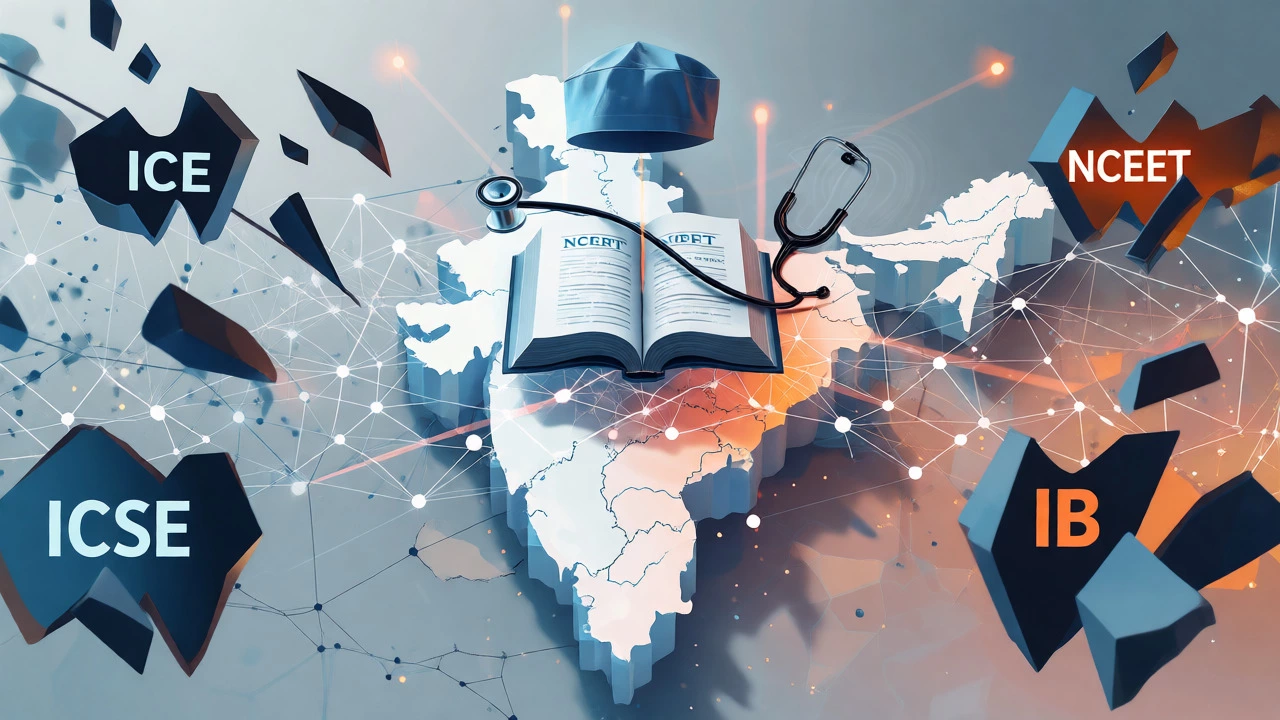
State Boards: The Wildcard Variable
Then there are State Boards. These vary wildly depending on where you live. Some, like Tamil Nadu or Maharashtra, have robust science streams. Others might lag behind in updating their syllabus to match modern medical trends.
The biggest risk with State Boards is inconsistency. One year, the state board might emphasize organic chemistry heavily; the next, it shifts focus. Meanwhile, NEET stays relatively stable. This mismatch means state board students often rely more heavily on external coaching to bridge the gap. If your state board has a reputation for being lenient or outdated, you might breeze through your 12th exams but struggle when faced with the rigorous, application-based questions of NEET.
However, don’t dismiss them entirely. Many top doctors come from state boards. The key is self-awareness. If your state board syllabus is close to NCERT, you’re fine. If it’s vastly different, you need a strict plan to cover NCERT independently.
What About International Boards Like IB or IGCSE?
Some affluent families consider the IB is the International Baccalaureate, a global educational program known for critical thinking and research projects. Or perhaps Cambridge IGCSE/A-Levels. These are fantastic for holistic development. They teach you how to research, write essays, and think critically-skills every good doctor needs.
But for the specific goal of cracking NEET in India? They are challenging. The IB biology curriculum, for instance, focuses heavily on practical assessments and internal assessments that don’t translate to NEET MCQs. Students from international boards often have to start their NEET prep from scratch in Class 11 or 12, ignoring much of their school coursework to focus purely on NCERT. Unless you plan to study medicine abroad (like in the UK or Australia), sticking to a board aligned with NEET saves you significant stress.

Decision Framework: How to Choose?
So, how do you decide? Don’t just follow the crowd. Use this simple checklist:
- Check the Syllabus Overlap: Open the latest NEET syllabus and your board’s Class 11 & 12 syllabus. How much matches? If it’s over 80%, go for it.
- Evaluate Coaching Access: Are there good NEET coaching centers near your school that support your board’s schedule? CBSE students usually have more options.
- Honest Self-Assessment: Can you handle a heavier workload? If you’re already struggling with basics, adding the extra depth of ICSE or IB might lead to burnout before NEET even arrives.
- Look at Alumni Success: Talk to seniors from your target school. Did they get into good medical colleges? What did they say was the hardest part? Real data beats rumors.
Remember, the board provides the environment, but you provide the effort. A motivated CBSE student who ignores NCERT will fail. A dedicated ICSE student who masters NCERT alongside their books will thrive. But why make it harder on yourself if you don’t have to?
Beyond the Board: Skills That Actually Make You a Good Doctor
Once you clear the entrance hurdle, your board becomes irrelevant. What matters then? Empathy. Stamina. The ability to stay calm under pressure. Interestingly, some studies suggest that students from diverse educational backgrounds bring different strengths to medical school. CBSE students might be faster at recalling facts. ICSE students might be better at writing case reports. State board students might have gritted their teeth through resource constraints and developed resilience.
Your choice of board today shapes your next two years. Choose wisely, but don’t panic. The path to medicine is long, and your board is just the first step, not the destination.
Is CBSE mandatory for NEET?
No, CBSE is not mandatory. Students from ICSE, State Boards, and even International Boards (like IB or Cambridge) are eligible to take NEET, provided they have studied Physics, Chemistry, and Biology in their qualifying examination.
Which board has the easiest syllabus for NEET preparation?
CBSE is generally considered the most efficient for NEET preparation because its syllabus is nearly identical to the NEET syllabus, which is based on NCERT textbooks. This reduces the need for supplementary study materials compared to other boards.
Can ICSE students compete with CBSE students in NEET?
Yes, absolutely. Many top NEET rankers come from ICSE backgrounds. However, ICSE students must proactively integrate NCERT study into their routine, as their school textbooks often contain extra material not tested in NEET.
Do state board marks matter for medical college admissions?
For most central universities and private colleges, only the NEET score matters. However, some state quota seats may require a minimum percentage in Class 12th board exams (usually 50% for general category). Always check specific state eligibility criteria.
Should I switch from ICSE to CBSE in Class 11 for NEET?
Switching mid-stream can be disruptive due to differences in teaching styles and assessment methods. It is often better to stick with your current board and supplement your studies with NCERT books specifically tailored for NEET, rather than risking adjustment issues.