Find Your Perfect Indian School Board
Stop guessing which board is "toughest." Let's find out which one is toughest for you. Answer these questions honestly to see which system aligns with your strengths.
Question 1: What is your primary academic goal?
Your Recommended Path
Board Name
Description goes here...
Key Considerations
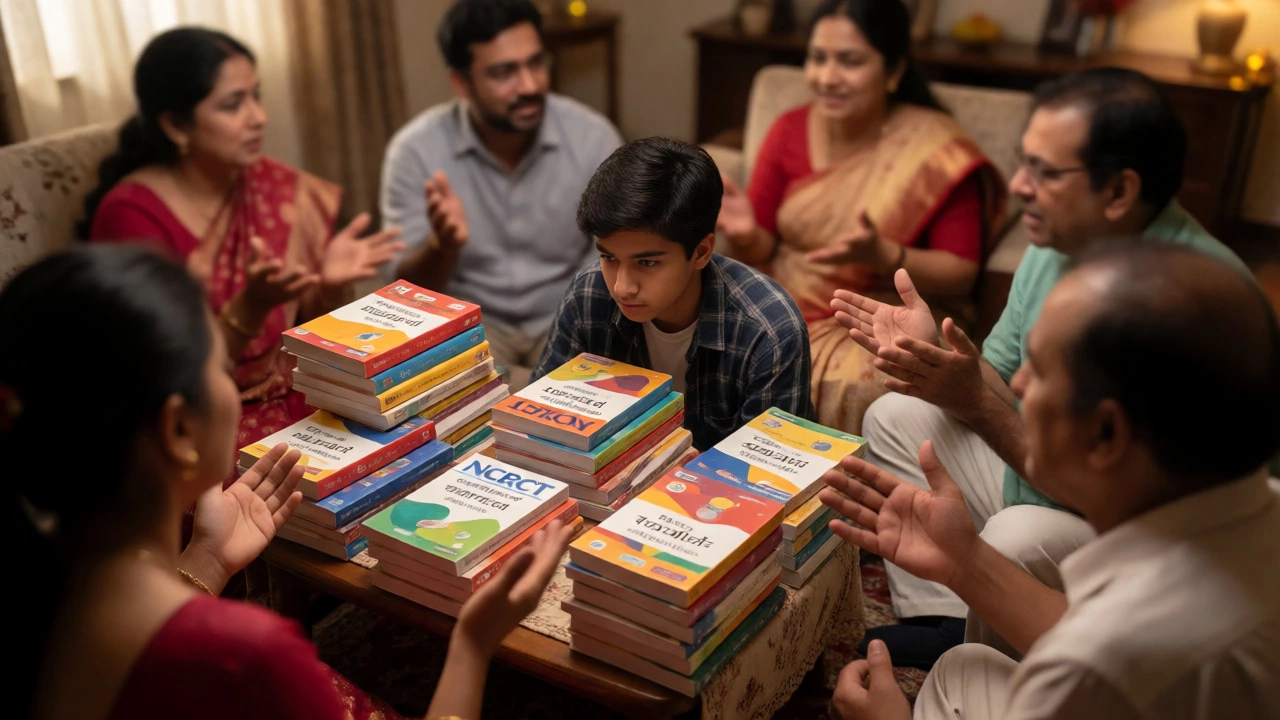
You have probably heard this debate at every family gathering, teacher's meeting, or WhatsApp group chat. "My cousin got 98% in the State Board but only 85% in CBSE." Or, "ICSE students struggle with JEE because their biology is too detailed." It creates a lot of anxiety for parents and students trying to pick the right path. But is there actually a single toughest board in India?
The honest answer is: no. There is no objective ruler to measure difficulty across different systems. What feels hard depends entirely on what you are good at. A student who loves memorizing facts might find one board easy, while another who likes solving problems from first principles will hate it. Let’s break down why this question is so tricky and help you figure out which board is toughest for you.
Why Comparing Boards Is Like Comparing Apples to Oranges
India’s education landscape is fragmented. You have national boards like CBSE (Central Board of Secondary Education) and ICSE (Council for the Indian School Certificate Examinations), plus dozens of state boards. Each has its own philosophy, marking scheme, and exam pattern.
Think of it this way. If you judge a fish by its ability to climb a tree, it will always look stupid. Similarly, if you compare a rote-learning-focused exam with an application-based exam using a single metric, the results are misleading. The "difficulty" often comes from mismatched expectations rather than the content itself.
For instance, CBSE questions are often direct and predictable. If you study the NCERT textbooks thoroughly, you can score high. ICSE, on the other hand, asks obscure details from outside the main textbook. State boards vary wildly-some are easier than CBSE, some are harder, and many depend heavily on the specific school and local teachers.
The Case for CBSE Being the Toughest
Many people argue that CBSE is the toughest because it is the standard for competitive exams like JEE and NEET. This is partially true, but let’s unpack it.
CBSE follows a strict curriculum based on NCERT books. The advantage here is clarity. Everything you need is in those books. The disadvantage? The competition is massive. Millions of students take these exams. To stand out, you don’t just need to pass; you need near-perfect scores. The pressure isn’t necessarily from the complexity of the questions, but from the sheer volume of students competing for the same ranks.
Also, CBSE has shifted towards competency-based questions in recent years. These aren’t just "define photosynthesis" type questions. They ask you to apply concepts to real-life scenarios. For a student used to cramming definitions, this shift makes CBSE feel much harder. But for a student who understands the logic, it’s actually more forgiving because you can derive answers even if you forget the exact wording.
Why ICSE Often Feels Harder
If you ask students who switched from ICSE to CBSE, many say ICSE was tougher. Why? Because ICSE demands depth over breadth. The syllabus is extensive. In subjects like Biology and History, ICSE expects you to know minute details that CBSE might skip.
Consider English. In CBSE, English literature focuses on a few core texts. In ICSE, you might have to analyze multiple plays, poems, and novels with critical commentary. The marking scheme is also stricter. Small errors in grammar or spelling can cost you marks. For students who are meticulous readers and writers, ICSE rewards them. For those who prefer quick summaries, it’s a nightmare.
Moreover, ICSE schools often have higher academic expectations internally. Assignments, projects, and internal assessments carry significant weight. The workload is consistently heavy throughout the year, not just before exams. This sustained pressure makes it feel tougher than CBSE, where the focus is often concentrated around the final board exams.
The Wild Card: State Boards
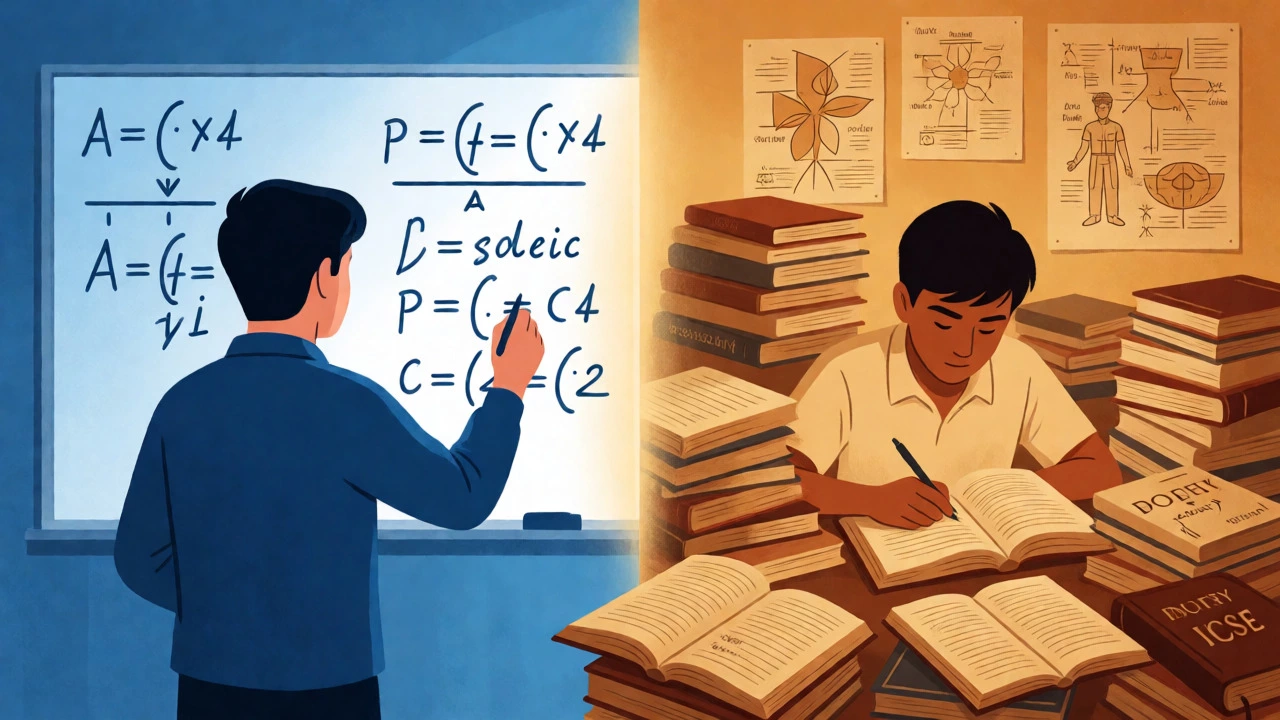
Here is where things get messy. There is no single "State Board." The Maharashtra State Board, Tamil Nadu State Board, UP Board, and Bihar Board are all completely different animals.
Some state boards, like those in Kerala or Karnataka, have updated their curricula to be more analytical and closer to CBSE standards. Others still rely heavily on rote learning. In many rural areas, the difficulty level is lower simply because the resources are limited. Students might score 90%+ easily, but when they move to cities for college, they struggle to keep up with peers from CBSE or ICSE backgrounds.
However, don’t underestimate them. Some state boards have notoriously difficult math papers. For example, the Telangana and Andhra Pradesh intermediate boards have been known to set challenging problems that test conceptual clarity deeply. If you are in a state board with a rigorous tradition, you might find it harder than a typical CBSE school.
How Difficulty Impacts Future Careers
You might wonder, "Does it really matter which board I choose?" Yes, it does, but maybe not in the way you think.
- Engineering and Medical Entrance: CBSE aligns best with JEE Main and NEET. Since most coaching institutes use CBSE/NCERT patterns as a baseline, CBSE students have a home-field advantage. ICSE students often have to re-learn certain topics in a simplified format to crack these exams.
- Law and Humanities: ICSE students often excel here. Their training in critical analysis, essay writing, and detailed reading gives them an edge in CLAT or university-level humanities courses.
- International Universities: IB (International Baccalaureate) is generally considered the toughest due to its workload and holistic assessment. However, between CBSE and ICSE, international admissions officers treat them similarly, looking more at your grades and extracurriculars than the board name.
| Feature | CBSE | ICSE | State Boards |
|---|---|---|---|
| Primary Focus | Conceptual clarity & Competitive Exam prep | Language proficiency & Detailed subject knowledge | Varies by state; often Rote learning + Local context |
| Textbook Dependency | High (NCERT is bible) | Low (Reference books essential) | Medium (State prescribed books) |
| Exam Pattern | Predictable, Structured | Unpredictable, Detailed | Varies widely |
| Best For | JEE/NEET aspirants | Humanities, Law, Arts | Students staying within state for undergrad |
| Perceived Difficulty | Moderate (High competition) | High (Heavy workload) | Low to High (Depends on state) |

It’s Not About the Board, It’s About the Student
Let’s flip the script. Instead of asking "Which board is toughest?", ask "What kind of learner am I?"
If you hate ambiguity and love clear-cut answers, CBSE will feel easier. You know exactly what to study. If you enjoy digging deeper into topics and don’t mind extra reading, ICSE will suit you. If you want a balanced approach with less pressure, a good state board might be the best choice.
Consider a real scenario. Two students, Aarav and Priya, both aim for top engineering colleges. Aarav attends an ICSE school. He spends hours analyzing literature and writing long essays. When he starts JEE prep, he struggles with the speed required for physics problems. Priya attends a CBSE school. She practices numerical problems daily. She finds JEE prep intuitive. Was ICSE tougher? No. It was just misaligned with his goal.
This is why blaming the board is a trap. The board sets the framework, but your effort, strategy, and mindset determine success. A lazy student will fail in any board. A disciplined student will thrive in all of them.
Practical Tips for Choosing the Right Path
So, how do you decide? Here is a simple checklist.
- Identify Your Goal: Are you aiming for IIT/JEE? Go for CBSE. Want to study abroad or pursue law/arts? Consider ICSE or IB.
- Evaluate the School, Not Just the Board: A great CBSE school with dedicated teachers beats a mediocre ICSE school. Look at the faculty quality and past results.
- Assess Your Learning Style: Do you panic with vague questions? Avoid boards with highly subjective grading. Do you get bored with repetition? Avoid boards that repeat the same questions yearly.
- Check Resource Availability: Can you easily find tutors and materials for your chosen board in your city? CBSE resources are everywhere. Niche state boards might have fewer options.
The Verdict
Is there a toughest board? Technically, IB is often cited as the most demanding due to its global standards and internal assessment load. Among national boards, ICSE is frequently perceived as academically tougher due to its vast syllabus and language emphasis. CBSE feels tough because of the intense competition and high stakes of entrance exams. State boards are inconsistent.
Don’t let fear drive your decision. Choose the board that aligns with your strengths and future goals. Once you are in, work smart. The board doesn’t define your intelligence; your preparation does.
Is CBSE easier than ICSE?
Generally, yes, in terms of syllabus size and language complexity. CBSE relies heavily on NCERT textbooks, making it more focused. ICSE requires studying beyond textbooks and places a heavier emphasis on English proficiency and detailed subject knowledge, which many students find more challenging.
Which board is better for JEE preparation?
CBSE is widely considered better for JEE preparation because the JEE Main syllabus closely mirrors the CBSE/NCERT curriculum. Coaching institutes also structure their teaching around CBSE patterns, giving CBSE students a slight advantage in alignment and resource availability.
Are state boards recognized internationally?
Yes, major state boards are recognized by universities worldwide. However, admission committees may require additional documentation or standardized tests (like SAT/ACT) to verify academic rigor compared to international boards like IB or Cambridge. Grades from reputable state boards are accepted, but the reputation of the specific school matters significantly.
Does switching boards affect college admissions?
Switching boards mid-stream can be challenging due to syllabus differences, especially in Class 11 and 12. For undergraduate admissions, colleges look at your Class 12 percentage and entrance exam scores. As long as you meet the cutoff, the board itself rarely causes rejection, provided the board is recognized by UGC/AICTE.
Which board has the highest pass percentage?
Pass percentages vary by year and region. Historically, some state boards report higher pass rates than CBSE or ICSE. However, high pass rates don't always equate to high academic standards. CBSE and ICSE tend to have stricter evaluation criteria, resulting in slightly lower average pass percentages but potentially more rigorous grading.