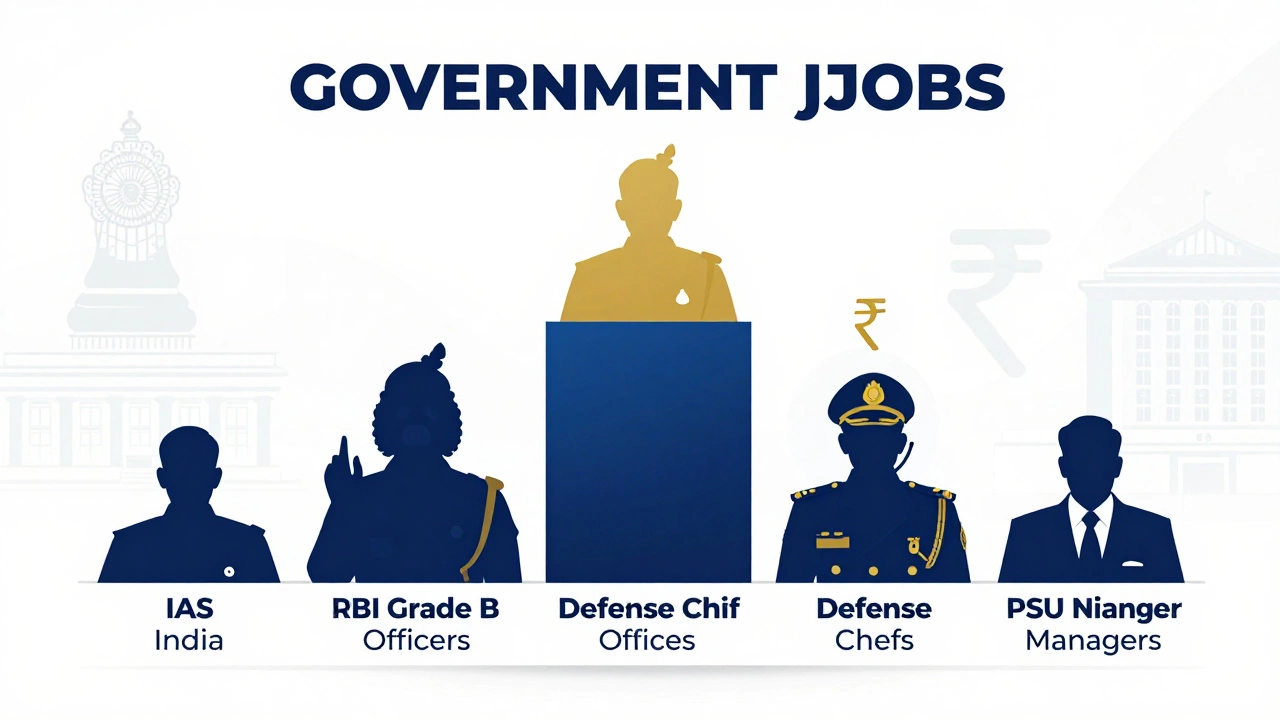
Government Salary & Career Path Calculator
Estimate your potential starting income and get personalized career advice based on your educational background.
Most people chase government jobs for one reason: stability. But let’s be honest, if you are asking which role pays the most, you aren’t just looking for a safe desk; you want financial freedom and a lifestyle that matches your ambition. The idea that all government salaries are capped at a modest level is outdated. In 2026, certain government roles offer compensation packages that rival or even exceed top private-sector management positions.
The truth is, not all government jobs are created equal. A clerk in a local office will never earn what a policy maker in New Delhi does. To maximize your income, you need to target specific sectors-primarily defense, finance, and high-level administration. These roles come with steep entry barriers, rigorous exams, and intense competition, but the payoff is substantial.
Key Takeaways
- Highest Base Salary: Cabinet Secretary and Defense Chiefs (Army Chief, Navy Chief) command the highest pay scales, often exceeding ₹2.5 lakh per month plus massive allowances.
- Best Entry-Level Pay: RBI Grade B Officer and SEBI Grade A roles start with higher basic pay and better perks compared to standard Group A civil services.
- Wealth vs. Cash: Administrative roles like IAS/IPS have lower base salaries than technical roles but offer significant 'perks' (housing, vehicles, staff) that reduce living costs drastically.
- The Hidden Cost: High-paying government jobs require 1-3 years of dedicated preparation, meaning you sacrifice immediate income for long-term gain.
The Hierarchy of Government Pay Scales
To understand which job is "best" for money, you first need to understand how government pay works. It isn't just about the number in your bank account. It's about the 7th Central Pay Commission (CPC), which defines the salary structure for central government employees in India. This commission sets the Basic Pay, Dearness Allowance (DA), House Rent Allowance (HRA), and other benefits.
For most senior roles, we look at the Ayushman Bharat Scheme is unrelated, but the Pay Matrix Level 10 to Level 18 is critical. Level 10 starts around ₹56,100, while Level 18 (the highest for non-cabinet secretaries) tops out near ₹2.5 lakh. However, the real money lies in the allowances. A district collector might earn less in cash than a senior engineer at a PSU, but the Collector lives rent-free in a mansion with a driver and security. That is an implicit monthly saving of ₹40,000-₹60,000.
When evaluating "best for money," you must calculate Total Compensation = Basic Pay + DA + HRA + Special Allowances + Perks Value. Ignoring perks leads to wrong decisions.
Top 5 Highest-Paying Government Jobs in India
Here are the roles that consistently rank at the top of the income ladder. Note that these are not entry-level positions for everyone; they require clearing some of the toughest exams in the country.
| Role / Service | Entry Exam | Starting Basic Pay (Approx.) | Key Financial Perk |
|---|---|---|---|
| Indian Administrative Service (IAS) | UPSC Civil Services | ₹56,100 (Level 10) | Official residence, vehicle, staff, medical |
| Indian Police Service (IPS) | UPSC Civil Services | ₹56,100 (Level 10) | Armed force allowance, housing, security |
| RBI Grade B Officer | RBI Grade B Exam | ₹35,150 + Special Allowance (~₹90k total) | Cheaper work hours, no field transfers |
| Defense Services (Officer) | NDA / CDS / AFCAT | ₹56,100 (Level 10) | Free food, lodging, fuel, medical for family |
| PSU Manager (GAIL/IOCL) | GATE Score | ₹1,00,000+ (Level 12 equivalent) | High bonus, profit sharing, early retirement options |
1. Indian Administrative Service (IAS)
The IAS officer is often called the "kingpin" of the bureaucracy. While the starting basic pay is ₹56,100, the Special Allowances can double this amount depending on the posting location. An Additional District Magistrate (ADM) earns significantly more due to special grade pay. By the time you reach Joint Secretary level (after 15-20 years), your take-home can exceed ₹1.5 lakh. The real value, however, is the power to influence policy and the network you build, which can lead to lucrative post-retirement corporate board positions.
2. Reserve Bank of India (RBI) Grade B
If you want high cash flow without the stress of rural postings, RBI Grade B is arguably the best choice. The RBI Grade B Officer is a managerial position in India's central bank responsible for monetary policy and regulation. Unlike IAS, you stay in metros or major cities. The starting package is around ₹90,000-₹1,00,000 per month after allowances. The work-life balance is superior, allowing you to invest your surplus income wisely. Many officers transition to private banking or consulting later, leveraging their regulatory expertise.
3. Public Sector Undertakings (PSUs) via GATE
Don't overlook PSUs like Oil and Natural Gas Corporation (ONGC), Gas Authority of India (GAIL), or NTPC. These companies hire managers through the GATE exam. A Management Trainee here starts with a basic pay of ₹70,000-₹80,000, plus a performance-linked incentive that can add another ₹20,000-₹50,000 monthly. They also offer stock options and profit-sharing bonuses, which are rare in traditional civil services. If you have an engineering background, this is often the fastest route to a six-figure salary.
4. Indian Foreign Service (IFS)
IFS officers represent India abroad. Their base pay is similar to IAS, but they receive Foreign Duty Allowance and Hardship Allowance when posted in difficult or remote locations. Living in countries like the US, UK, or Singapore means your salary goes much further due to exchange rates. You get free housing, international school fees for kids, and diplomatic immunity. While the cash in hand might look similar to IAS, the purchasing power parity (PPP) makes IFS one of the wealthiest lifestyles in the government sector.
5. Defense Services (Commanding Officers)
Joining as an officer in the Army, Navy, or Air Force guarantees zero living expenses. Your food, accommodation, travel, and medical care are fully covered. What you earn is essentially disposable income. A Lieutenant Colonel can save upwards of ₹1 lakh per month because they spend almost nothing on daily life. Post-retirement, veterans often find high-paying roles in security consulting or defense manufacturing.
Hidden Costs of High-Paying Government Jobs
Before you dive into preparation, consider the opportunity cost. Preparing for UPSC or RBI takes 1-2 years of full-time study. During this time, you earn nothing. If you compare this to joining a private IT firm immediately, you lose 2 years of salary (approx. ₹10-15 lakhs). However, over a 30-year career, the government pension (New Pension Scheme), tax exemptions, and job security outweigh this initial loss.
Also, remember that "money" isn't just cash. Stress levels in IAS/IPS are incredibly high. Corruption allegations, political pressure, and frequent transfers disrupt family life. RBI and PSUs offer a more stable environment, which has its own monetary value in terms of mental health and family time.
How to Choose Based on Your Background
- Humanities/Arts Graduates: Aim for UPSC (IAS/IPS/IFS). It’s the only path where your degree doesn't limit your earning potential.
- Commerce/Finance Graduates: Target RBI Grade B, SEBI Grade A, or IRDAI Assistant Manager. These roles respect financial acumen and pay well.
- Engineering Graduates: Don't waste your degree on generalist exams. Use GATE for PSUs (ONGC, NTPC, BHEL). The starting salary is higher, and promotions are faster.
- Science/Medical Graduates: Consider AIIMS or DRDO. While not as flashy as IAS, the specialized nature of these jobs ensures high demand and good pay scales.
Frequently Asked Questions
Which government job has the highest starting salary in India?
Public Sector Undertakings (PSUs) like ONGC, GAIL, and IOCL typically offer the highest starting salaries, often exceeding ₹1,00,000 per month including allowances and incentives. Among civil services, RBI Grade B offers a strong starting package of around ₹90,000-₹1,00,000, which is higher than the initial basic pay of IAS/IPS officers before special allowances kick in.
Is IAS salary higher than IPS salary?
The basic pay for IAS and IPS is identical as they both fall under the same pay matrix (Level 10). However, IPS officers may receive additional armed force allowances depending on their specific posting and risk factors, which can slightly increase their take-home pay compared to IAS officers in administrative roles.
Can government employees earn extra income from side businesses?
Generally, no. Active government servants, especially those in All India Services (IAS, IPS, IFS), are strictly prohibited from engaging in any trade, business, or employment outside their official duties. Violating this rule can lead to disciplinary action. However, they can invest in stocks, mutual funds, and real estate passively.
What is the average salary of an IAS officer after 10 years?
After 10 years, an IAS officer typically holds the rank of Deputy Secretary or Director. Their basic pay moves to Level 13 or 14, resulting in a take-home salary ranging between ₹1.2 lakh to ₹1.8 lakh per month, excluding valuable perks like official housing and transport.
Are PSU jobs better than UPSC jobs for money?
For pure cash flow in the first 15 years, yes. PSUs offer higher starting salaries and performance bonuses. However, UPSC jobs (IAS/IPS) offer greater social prestige, power, and potentially more lucrative post-retirement opportunities in corporate boards and think tanks, which can generate significant wealth later in life.