IIT Admission Difficulty & Strategy Estimator
Configure Your Target
Enter details to see your admission outlook
Select an institute tier, branch, and location to analyze the competition level and required rank range.
Strategic Advice
Based on your selection...
There is a myth that walking through the gates of any Indian Institute of Technology (IIT) is equally difficult. If you believe that, you are setting yourself up for a strategic disaster in your IIT JEE preparation. The truth is starkly different. Getting an admission letter from IIT Madras for Civil Engineering requires a completely different level of performance than securing a seat at IIT Bombay for Computer Science and Engineering (CSE).
The "difficulty" of getting into an IIT is not a single number. It is a complex equation involving three variables: the prestige of the institute, the desirability of the branch, and the location. When you combine these, the gap between the "easiest" IIT seat and the "hardest" can span over 100,000 ranks in the Joint Seat Allocation Authority (JoSAA) counseling process.
The Hierarchy of Prestige: The "Old" vs. "New" Divide
To understand where the real competition lies, you first need to map the hierarchy. For decades, students and parents have grouped the institutes into tiers based on historical reputation, alumni networks, and placement records. While this is changing as newer institutes build their infrastructure, the market perception still heavily favors the original seven.
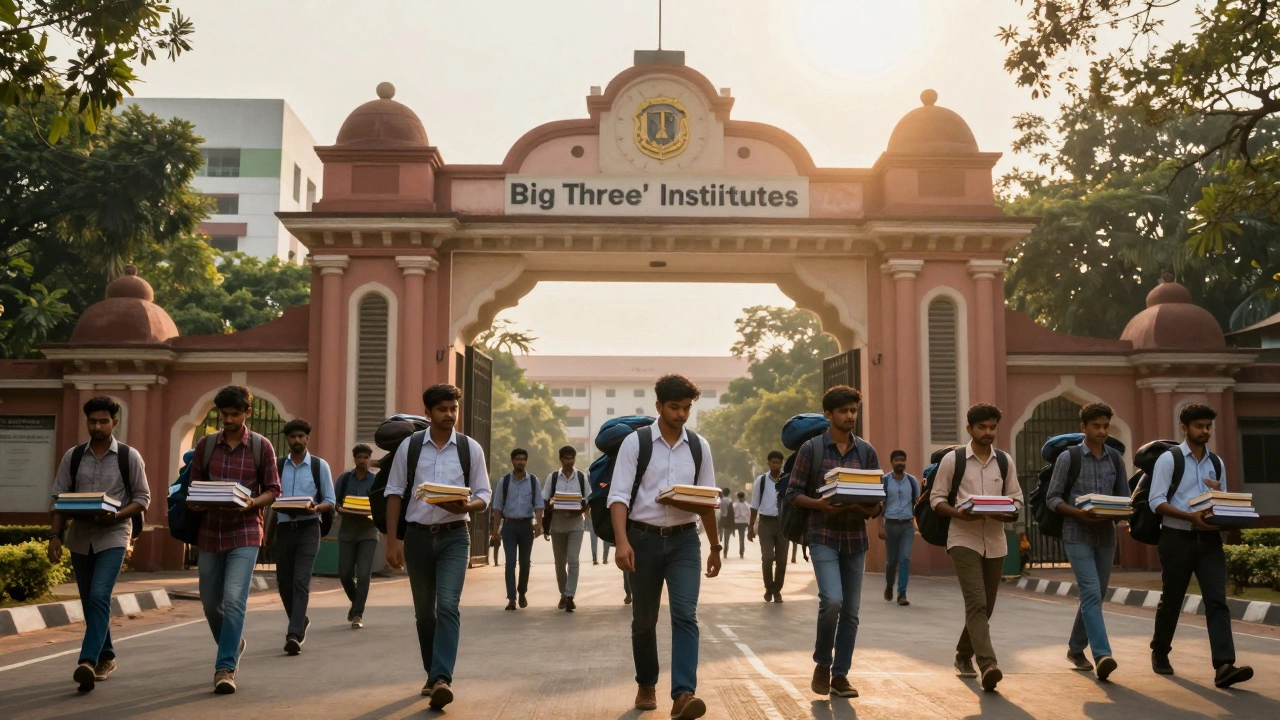
IIT Bombay, IIT Delhi, and IIT Kanpur sit at the very top of this pyramid. These are often referred to as the "Big Three." Following them closely are IIT Madras and IIT Kharagpur. Then come the slightly younger but rapidly rising stars like IIT Roorkee and IIT Guwahati.
Below these lie the newer IITs established after 2008, such as IIT Hyderabad, IIT Gandhinagar, and IIT Bhubaneswar. While these institutions offer world-class education and research opportunities, the sheer volume of applicants chasing seats there is lower compared to the older giants. Therefore, statistically, it is easier to get into a new IIT than an old one, assuming equal academic merit.
The Branch Factor: Why CSE Changes Everything
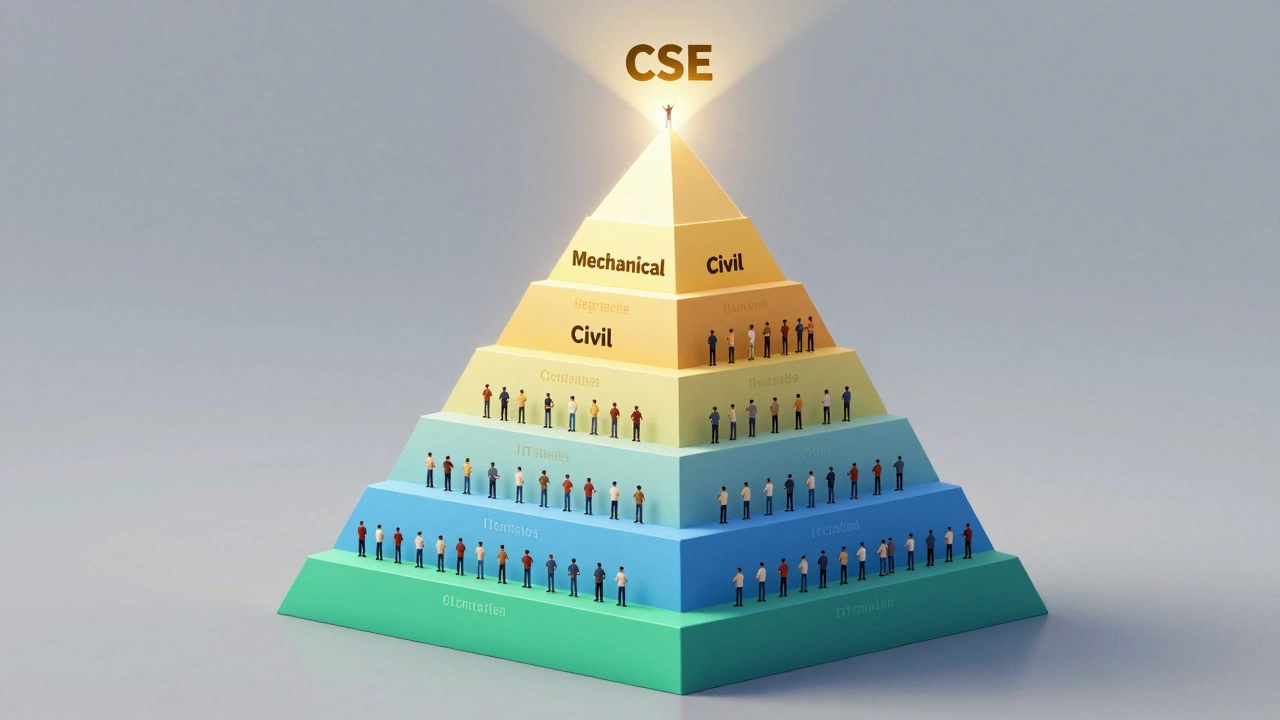
If you ask a student which is harder: IIT Bombay or IIT Madras? The answer depends entirely on the branch. This is the most critical insight for your strategy. Computer Science and Engineering (CSE) is the undisputed king of demand. It offers the highest starting salaries, the widest range of job profiles, and the strongest brand value in the tech industry.
Because of this, the cutoff rank for CSE at IIT Bombay is consistently the lowest (meaning the highest difficulty) in the entire country. In recent years, the closing rank for General category students in CSE at IIT Bombay has hovered around 100-200. You essentially need to be in the top 0.01% of all candidates who took the JEE Advanced exam.
Compare this to IIT Bombay's Metallurgical Engineering or Agricultural and Food Engineering. The closing ranks for these branches might extend to 3,000 or even 5,000. So, is IIT Bombay hard to get into? Yes. But is it harder to get into IIT Bombay Metallurgy than IIT Delhi CSE? No. IIT Delhi CSE will likely require a better rank than IIT Bombay Metallurgy.
This creates a paradox. A student aiming for "any branch" at IIT Bombay needs a significantly better rank than a student aiming for "CSE" at IIT Roorkee or IIT Hyderabad. Your target must be specific. Vague goals lead to wasted effort.
Location Bias: The Urban Advantage
Human behavior plays a huge role in admission statistics. Students prefer cities that offer lifestyle amenities, internship opportunities, and proximity to family. This "location bias" inflates the difficulty of getting into IITs located in major metropolitan areas.
IIT Bombay is in Mumbai, the financial capital. IIT Delhi is in New Delhi, the political capital. IIT Madras is in Chennai, a major tech hub. These locations attract students who want access to internships during summers without traveling far. Consequently, the cutoffs for these institutes are artificially higher due to preference, not just academic quality.
In contrast, IIT Patna, IIT Mandi, or IIT Tirupati are located in smaller towns or hill stations. While the education quality is comparable, the lack of immediate urban connectivity makes them less popular among risk-averse students. This results in lower cutoff ranks, making them relatively "easier" to crack if your primary goal is simply an IIT tag.
Data-Driven Reality: Closing Ranks by Category
Let’s look at the numbers. The difficulty is measured by the "Closing Rank" in JoSAA. A lower rank number means higher difficulty. Here is how the landscape looks for the General (UR) category, which faces the stiffest competition:
| Institute & Branch | Estimated Closing Rank | Difficulty Level |
|---|---|---|
| IIT Bombay - CSE | ~100-150 | Extreme |
| IIT Delhi - CSE | ~200-300 | Extreme |
| IIT Madras - CSE | ~300-400 | Very High |
| IIT Kanpur - CSE | ~400-500 | Very High |
| IIT Bombay - Mechanical | ~1,500-2,000 | High |
| IIT Roorkee - CSE | ~1,200-1,500 | High |
| IIT Hyderabad - CSE | ~2,500-3,000 | Moderate-High |
| Newer IITs - Core Branches | ~5,000-10,000 | Moderate |
Note that these numbers fluctuate yearly based on the difficulty of the JEE Advanced paper and the total number of qualifiers. However, the relative order remains stable. If you are from a reserved category (OBC-NCL, SC, ST), the ranks shift significantly, opening up opportunities in top branches at older IITs with much lower absolute scores. Always check the category-specific data.

The Hidden Challenge: Consistency Over Brilliance
Getting into the hardest IITs isn't just about being smart; it's about being consistent. The JEE Advanced exam tests endurance. It is a three-hour marathon of Physics, Chemistry, and Mathematics. Many brilliant students fail because they burn out before the exam or make careless mistakes under pressure.
The students who secure ranks under 100 don't necessarily know more concepts than those ranked 1,000. They have practiced solving problems faster and with fewer errors. They have mastered the art of elimination and time management. Your preparation plan should reflect this. Focus on mock tests that simulate the actual exam environment. Analyze every mistake. Understand why you got it wrong-was it a conceptual gap, a calculation error, or poor time allocation?
Strategic Advice for Aspiring Candidates
If your dream is the "hardest" seat, here is your roadmap:
- Start Early: Don't wait until Class 12. Build strong foundations in Class 11. The syllabus is vast, and cramming never works for JEE Advanced.
- Choose Resources Wisely: Stick to standard textbooks like HC Verma for Physics, OP Tandon for Chemistry, and RD Sharma or Arihant series for Mathematics. Supplement with online platforms for doubt resolution.
- Mock Tests are Non-Negotiable: Take at least 30-40 full-length mock tests before the actual exam. This builds the stamina required to focus for nine hours straight (JEE Main + Advanced combined stress).
- Be Realistic About Branches: If your rank is around 1,000, don't waste options on IIT Bombay CSE. Look at IIT Bombay Mechanical or IIT Delhi Electrical. The education quality is identical; only the brand perception differs.
- Consider the "Value