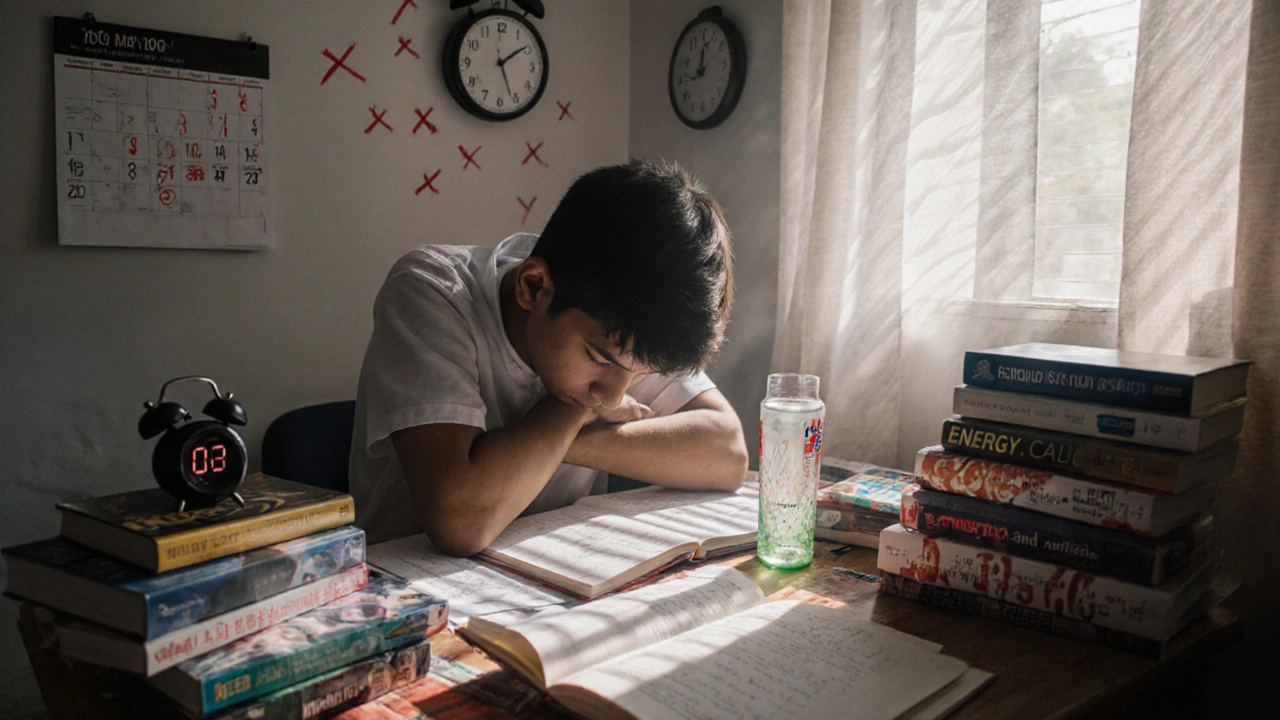
Ask any student who’s gone through the CBSE Class 12 exams, and they’ll tell you: it’s not just hard-it’s relentless. But is it the hardest in the world? The answer isn’t simple. Some countries design their school systems to produce top engineers. Others focus on critical thinking. A few push students to the edge just to see who can survive. The CBSE syllabus, especially when paired with IIT JEE preparation, sits at the center of one of the most intense academic ecosystems on the planet.
Why CBSE Feels Like a Marathon with No Finish Line
The Central Board of Secondary Education (CBSE) covers over 20,000 schools across India and another 200+ abroad. Its syllabus isn’t just dense-it’s engineered for competition. By Grade 10, students are already expected to master calculus, organic chemistry, and complex physics problems that many university freshmen in other countries won’t touch until Year 2.
Take Class 12 Physics: the NCERT textbook alone lists over 120 formulas. But CBSE doesn’t stop at memorization. Students must apply those formulas to multi-step numerical problems under timed conditions. In 2024, the average score in the CBSE Physics exam was 58%, the lowest among all core subjects. That’s not because students are lazy-it’s because the exam tests precision under pressure.
Mathematics is even tougher. The board includes topics like differential equations, vector algebra, and probability distributions-concepts that are optional in most Western high schools. And if you’re aiming for IIT JEE? You’re expected to solve problems 3x harder than what’s on the board exam. Thousands of students spend 12-16 hours a day for two years just to get a shot at one of the 12,000 seats in IITs.
How CBSE Compares to ICSE and Other Indian Boards
Many assume ICSE (Indian Certificate of Secondary Education) is harder because it has more subjects. That’s true-ICSE students take 10-11 subjects compared to CBSE’s 5-6. But quantity doesn’t equal difficulty. ICSE leans toward theory, essays, and broad understanding. CBSE leans toward speed, accuracy, and problem-solving under pressure.
Here’s the real difference:
- CBSE: Focuses on competitive exam readiness. If you’re studying for JEE or NEET, CBSE aligns directly with those patterns.
- ICSE: Focuses on language, literature, and analytical writing. It’s more balanced but less targeted.
- State Boards: Often easier. In states like Maharashtra or Tamil Nadu, the syllabus is simpler, and exam patterns are more predictable.
So if you’re asking which is hardest, it depends on your goal. If you want to crack IIT? CBSE is the battlefield. If you want to write a 2,000-word essay on Shakespeare? ICSE gives you more room.
The Global Comparison: IB, A-Levels, and the Chinese Gaokao
Outside India, other systems are known for their rigor. The International Baccalaureate (IB) Diploma Programme demands six subjects, a 4,000-word extended essay, creativity projects, and theory of knowledge. It’s broad, not narrow. IB students don’t just memorize-they analyze, debate, and reflect.
But here’s the catch: IB students have 3-4 years to spread out their workload. CBSE students have 2 years to cover what IB covers in 5. And unlike IB, CBSE doesn’t let you drop a subject if it’s tough. You have to pass all five core subjects-or you don’t graduate.
Then there’s the UK’s A-Levels. Students pick only 3-4 subjects and go deep. In A-Level Further Maths, the content rivals first-year university. But the exam window is longer. You get two sittings. CBSE gives you one shot, one day, one exam hall.
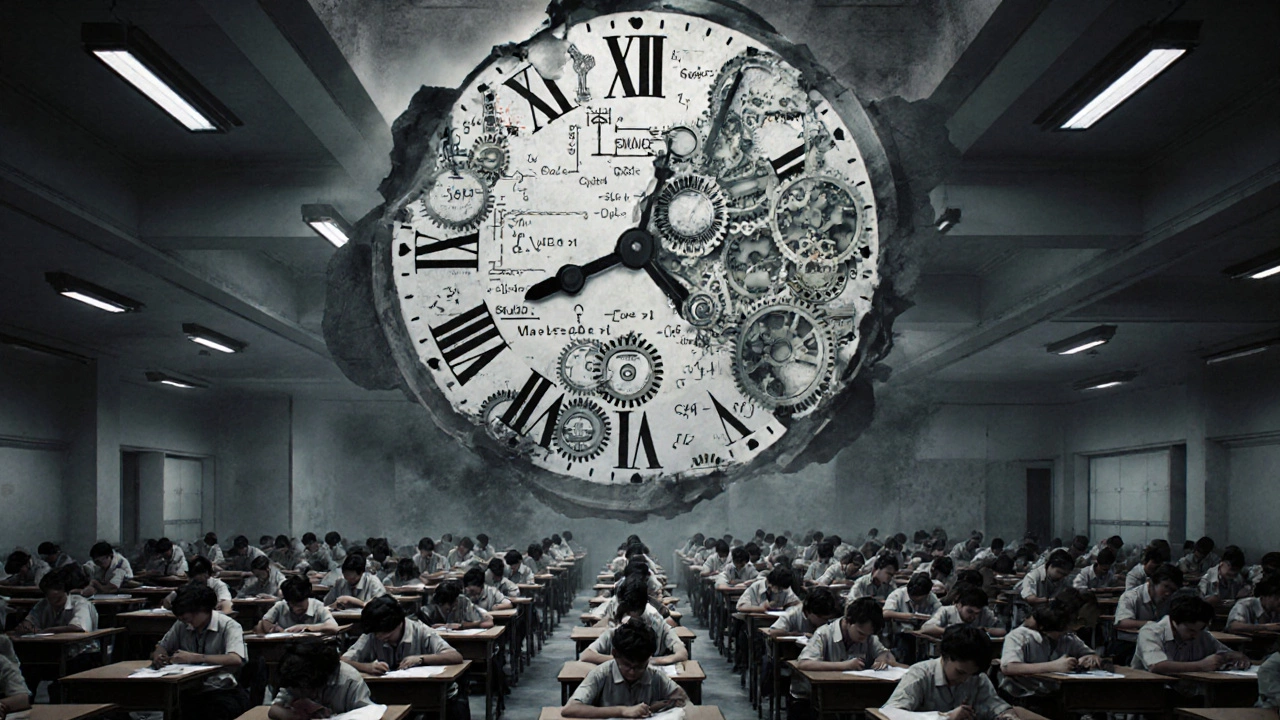
And then there’s China’s Gaokao. It’s the single most high-stakes exam on Earth. Over 12 million students take it each year. One exam decides your university, your career, even your social status. The Gaokao covers math, Chinese, English, and a science or humanities stream. The pressure is psychological. The content? Slightly less advanced than CBSE’s IIT-level math, but the stakes are higher.
What Makes CBSE the Hardest? The Hidden Factors
It’s not just the syllabus. It’s the ecosystem.
- Time pressure: CBSE exams are 3 hours for 70-80 questions. That’s under 2.5 minutes per question-with complex calculations.
- Zero tolerance for error: A single sign mistake in a 5-mark calculus problem can cost you the entire mark.
- Parental and societal pressure: In India, your board score isn’t just a grade-it’s a reflection of your family’s honor.
- Coaching culture: Most top CBSE students attend 4-6 hours of coaching daily after school. That’s a 12-hour school day, six days a week.
- No safety net: Unlike the IB, where internal assessments help, CBSE is 100% final exam. One bad day, and your future changes.
Compare that to Finland, where students have no standardized tests until age 16, or Canada, where report cards are based on continuous assessment. The contrast isn’t just academic-it’s cultural.
Who Actually Succeeds Under This System?
It’s not the smartest students who win. It’s the most consistent. The ones who wake up at 5 a.m., solve 50 math problems before breakfast, and review notes while eating lunch. They don’t have hobbies-they have schedules. They don’t take breaks-they take caffeine.
And yet, the dropout rate among CBSE students aiming for IIT is over 70%. That’s not because they’re not capable. It’s because the system doesn’t just test knowledge. It tests endurance.
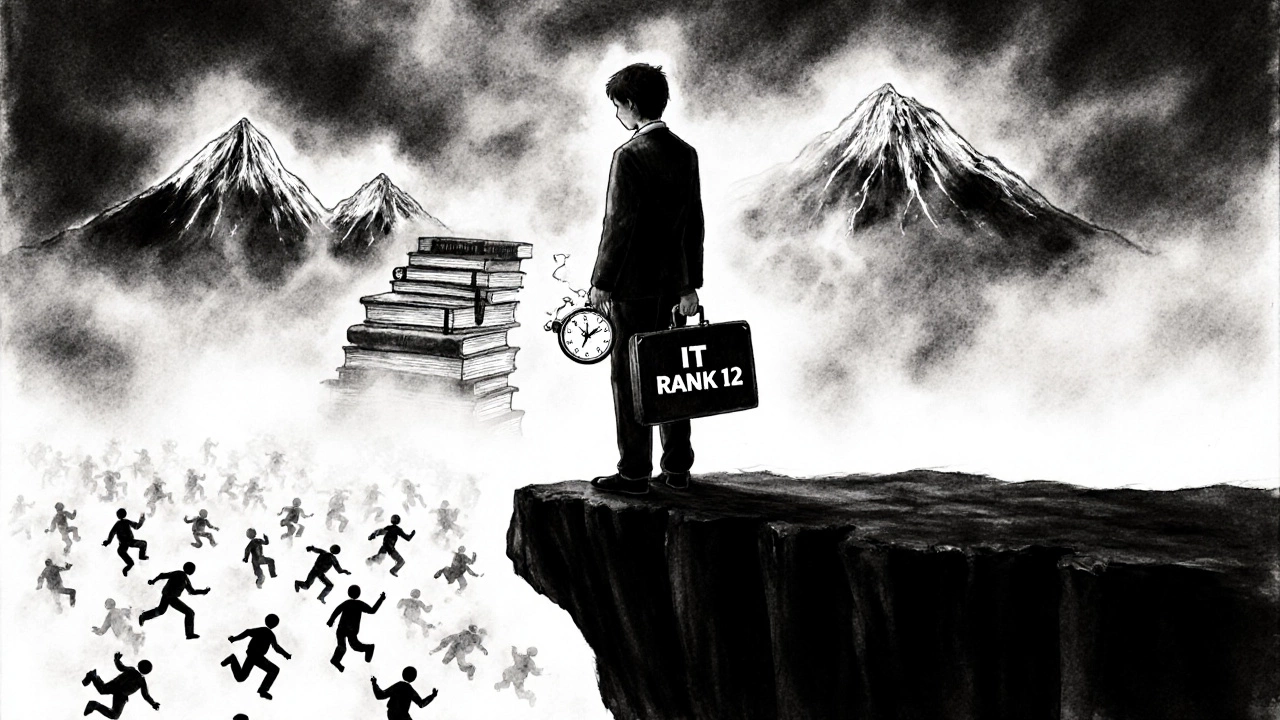
There are success stories, of course. In 2024, a student from Delhi scored 99.8% in CBSE and cracked IIT Bombay with an All India Rank of 12. But behind that number? Three years without a single vacation. No movies. No parties. No weekend trips. Just books, timers, and sleep deprivation.
Is It Worth It?
Some say the CBSE system produces the most resilient graduates on Earth. And there’s truth to that. Indian engineers from IITs dominate top tech firms in Silicon Valley. Indian doctors outperform global peers in USMLE exams.
But at what cost? Mental health issues among Indian high schoolers have spiked 300% since 2018. Suicide is the leading cause of death among teens aged 15-19 in states like Andhra Pradesh and Maharashtra. The system doesn’t break students because they’re weak. It breaks them because it’s designed to filter out everyone but the few.
So is CBSE the hardest syllabus in the world? By raw content, maybe not. The Gaokao has higher stakes. A-Levels go deeper. IB is broader. But when you combine content density, time pressure, societal expectations, and the lack of alternatives? CBSE, especially when paired with IIT JEE prep, becomes the most brutal academic gauntlet on the planet.
It’s not about being the smartest. It’s about being the toughest. And that’s why, for millions, CBSE isn’t just a syllabus-it’s a survival test.
Is the CBSE syllabus harder than the IB curriculum?
CBSE is more intense in terms of volume and speed, especially for STEM subjects. IB covers more subjects and requires critical thinking, but spreads the workload over two years. CBSE packs the same depth into one year with no room for error. For students aiming for IIT or NEET, CBSE is the direct path-and far more punishing.
Why is CBSE linked so strongly with IIT JEE preparation?
The CBSE syllabus for Class 11 and 12 is designed to align directly with the JEE Main and Advanced syllabus. Most JEE questions are based on NCERT textbooks, which are CBSE’s official material. Coaching institutes build their entire curriculum around CBSE content. If you’re not studying CBSE, you’re at a disadvantage before you even start preparing.
Do students in other countries face similar pressure?
Yes, but differently. In China, the Gaokao is a single exam that decides your future. In South Korea, students study until midnight and attend private academies called hagwons. In Japan, entrance exams for top universities are extremely competitive. But none combine the volume of content, the lack of flexibility, and the societal weight quite like CBSE + JEE.
Can a student switch from ICSE to CBSE for better JEE results?
Yes, and many do. ICSE students often struggle with the problem-solving style of JEE because their curriculum emphasizes theory over numerical application. Switching to CBSE in Grade 9 or 10 gives them access to NCERT-based problem patterns and coaching materials built specifically for JEE. It’s a common strategy among serious aspirants.
Is the CBSE syllabus changing to reduce student stress?
There have been minor reductions in content-like removing some chapters from Class 12 Physics in 2021-but the core pressure remains. The board still follows the same exam pattern: high difficulty, low tolerance for error, and no internal assessment. The goal hasn’t shifted from selection to survival. Real reform would require changing the entire competitive ecosystem, not just the syllabus.
If you’re navigating this system, know this: you’re not alone. Millions are walking the same path. But remember-your worth isn’t measured by a percentage. The hardest syllabus in the world doesn’t define you. How you rise after falling does.