JEE Topic Priority Calculator
Discover your highest-yield topics based on current knowledge levels
Physics
Chemistry
Mathematics
People say cracking IIT JEE in six months is impossible. But that’s not true. It’s hard? Absolutely. Impossible? No. I’ve seen it happen. Not often, but enough to know it’s doable-if you know exactly what to do and how to do it.
It’s Not About Time. It’s About Focus.
Most students think they need two years to prepare for IIT JEE. That’s the norm. But the norm doesn’t always win. In 2024, a student from Kota named Arjun Sharma cleared JEE Advanced in just six months. He didn’t start early. He didn’t have a private tutor. He didn’t even join a coaching center until four months before the exam. What he had was brutal focus.
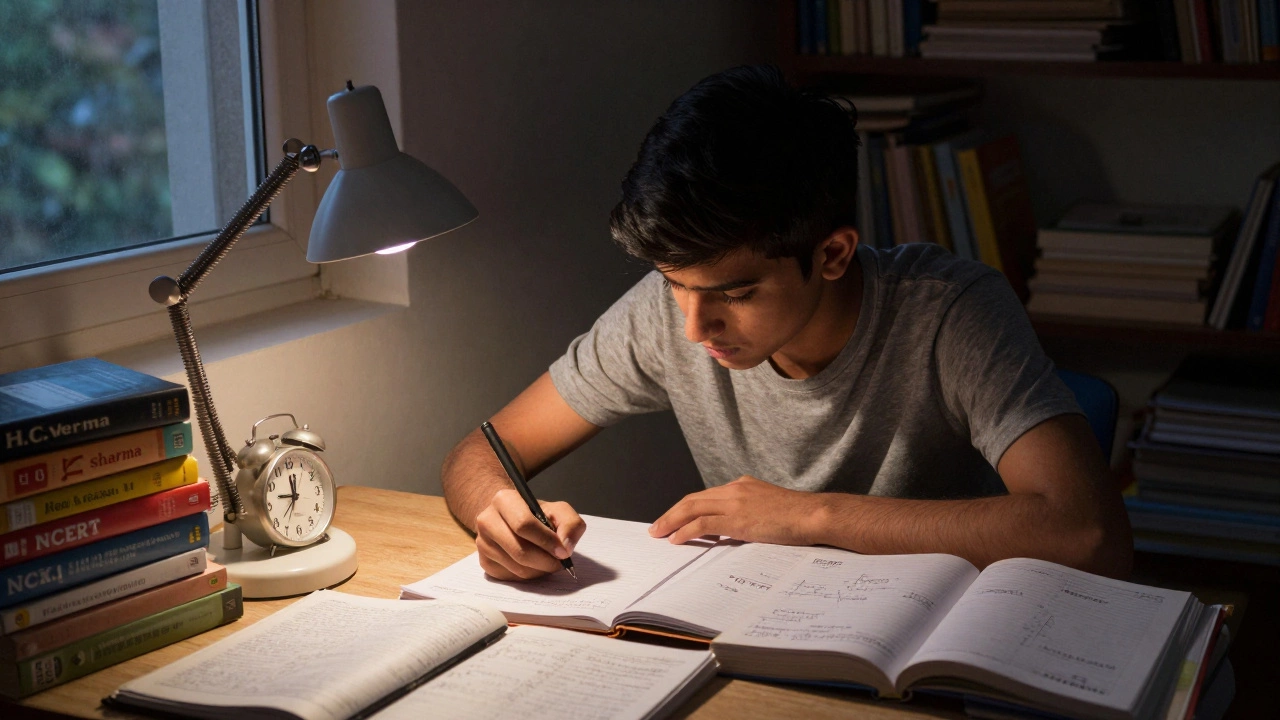
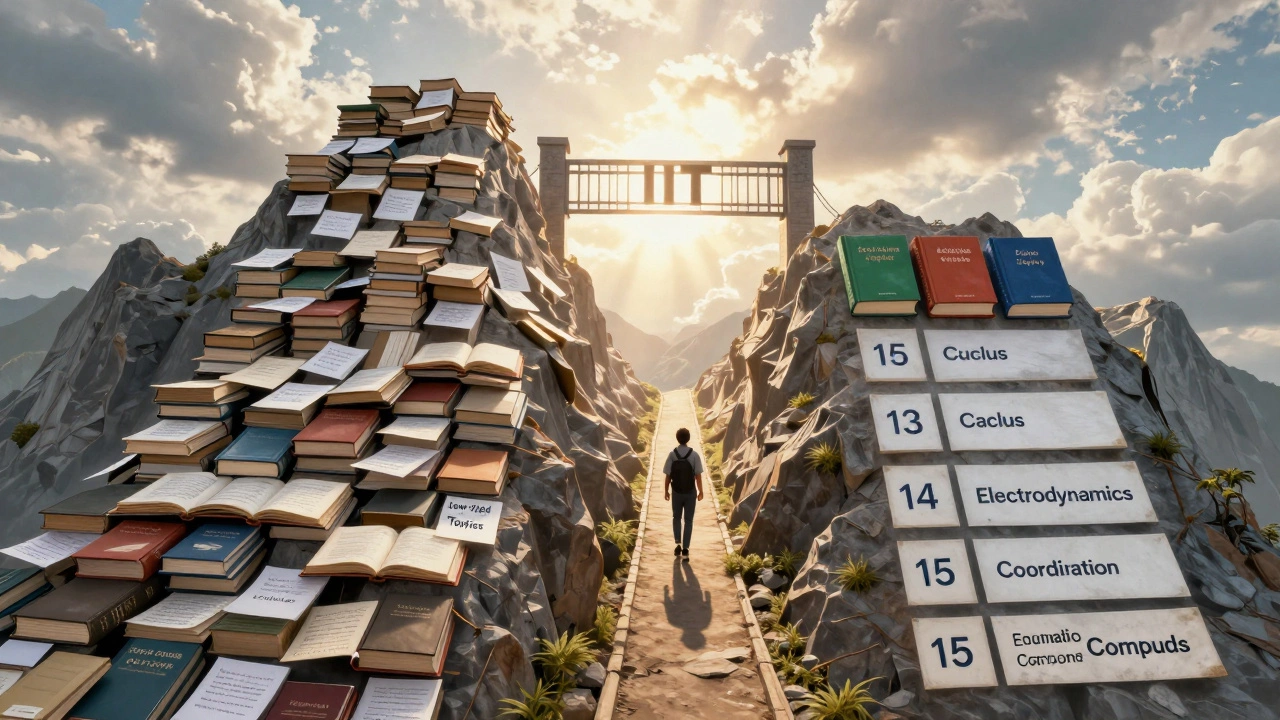
He dropped out of his 12th-grade regular school in January. He moved into a small room near a library. He woke up at 5 a.m. every day. He studied until 11 p.m. No social media. No YouTube. No phone calls unless it was urgent. He didn’t try to cover everything. He picked the highest-weightage topics and mastered them. Physics: Mechanics, Electrodynamics. Chemistry: Organic Reaction Mechanisms, Coordination Compounds. Maths: Calculus, Coordinate Geometry. That’s it. He didn’t touch half the syllabus. And he still got an All India Rank under 500.
That’s the secret: cracking IIT JEE in six months isn’t about doing more. It’s about doing the right things, perfectly.
What You Can’t Skip: The Core 40%
The JEE syllabus is huge. But 60% of the paper comes from just 40% of the topics. That’s the law of diminishing returns. Spend time on low-yield topics? You’ll burn out. Focus on high-yield ones? You’ll climb the rank list.
Here’s what you absolutely need to nail:
- Physics: Newton’s Laws, Rotational Motion, Electrostatics, Current Electricity, Magnetism, Optics (Ray and Wave), Modern Physics (Photoelectric, Nuclei)
- Chemistry: Organic: Aldehydes, Ketones, Carboxylic Acids, Amines, Biomolecules. Inorganic: Periodic Table trends, Coordination Compounds, Chemical Bonding, Metallurgy. Physical: Mole Concept, Thermodynamics, Equilibrium, Electrochemistry
- Mathematics: Calculus (Limits, Differentiation, Integration), Coordinate Geometry (Straight Lines, Circles, Parabola), Algebra (Quadratic, Matrices, Probability), Trigonometry
These 15-18 topics appear in 70-80% of JEE Advanced questions. Ignore the rest. Don’t even open those chapters until you’ve mastered these. You’ll save weeks. And you’ll gain confidence.
How to Study: The 80/20 Daily Routine
Most students waste hours solving 50 problems they already know. That’s not practice. That’s repetition. Real practice means solving problems you don’t know-until you do.
Here’s how a six-month winner structures their day:
- 5:00-6:30 a.m. Review yesterday’s mistakes. No new topics. Just fix errors. Write them in a notebook. Review this notebook every Sunday.
- 6:30-8:00 a.m. One topic deep dive. Read theory from NCERT or a single trusted book (like HC Verma for Physics, OP Tandon for Chemistry, RD Sharma for Maths). No distractions. No switching books.
- 8:00-10:00 a.m. Solve 15-20 targeted problems. Not random. Pick problems from past JEE papers (2015-2024). Focus on the type that trips you up.
- 10:00-10:30 a.m. Break. Walk. Drink water. No phone.
- 10:30 a.m.-1:00 p.m. Mock test section. One full section (Physics, Chemistry, or Maths) timed. 90 minutes. No stopping.
- 1:00-2:00 p.m. Lunch. Rest.
- 2:00-4:00 p.m. Analyze the mock. Why did you get it wrong? Was it a concept gap? A calculation error? A misread? Write it down.
- 4:00-5:30 p.m. Revise weak areas from the morning. Re-solve one problem you got wrong. Then move on.
- 5:30-7:00 p.m. Light exercise. Walk. Stretch. Breathe.
- 7:00-9:30 p.m. Solve 5-7 advanced problems from previous JEE Advanced papers. These are the ones that take 10-15 minutes each. No shortcuts.
- 9:30-11:00 p.m. Sleep. No studying after this. Your brain consolidates memory while you sleep.
This isn’t about working 16 hours. It’s about working 10 hours with laser focus. The rest is recovery. Recovery is part of the strategy.
Books You Need (and the Ones You Don’t)
You don’t need 20 books. You need three. And you need to finish them.
- Physics: Concepts of Physics by H.C. Verma (Vol 1 & 2) - the only book you need. Solve every example and exercise. Don’t skip the derivations.
- Chemistry: Organic Chemistry by Morrison & Boyd (for concepts), Concise Inorganic Chemistry by J.D. Lee, and NCERT for inorganic. That’s it.
- Mathematics: Objective Mathematics by R.D. Sharma for basics. Then Problems in Calculus of One Variable by I.A. Maron for advanced. Skip Arihant’s 40-year papers unless you’ve finished these.
Don’t buy new books every month. Don’t switch coaching material every week. Stick. One source. One path. Mastery beats variety every time.
The Mental Game: You Will Hit a Wall
By month three, you’ll feel like giving up. Your scores will drop. You’ll see others scoring higher. You’ll wonder if you’re wasting your time. That’s normal. Everyone hits this wall. The difference between those who quit and those who break through? They keep going.
Here’s what works:
- Track your progress weekly. Not daily. Weekly. Write down: ‘This week, I improved in electrostatics. I solved 12 past JEE problems correctly.’
- Don’t compare yourself to others. You’re not racing them. You’re racing your past self.
- On bad days, do one thing: solve one problem you used to hate. Then stop. That’s your win.
- Get 7 hours of sleep. No exceptions. Sleep is your secret weapon.
One student I know, Priya, failed her first mock test in February. Scored 80 out of 300. She cried. She thought she was done. But she didn’t quit. By June, she scored 276. Got into IIT Delhi. Not because she was smart. Because she didn’t quit.

Can You Do It? The Real Answer
Yes. But only if you’re willing to trade everything else for six months. No parties. No Netflix. No weekend trips. No phone scrolling. No ‘I’ll start tomorrow.’
You don’t need genius. You need consistency. You don’t need to know everything. You need to know the right things, better than anyone else.
If you’re reading this and you’re 16, with six months left, and you’re scared-good. Fear means you care. Now use it. Start today. Not tomorrow. Today.
Cracking IIT JEE in six months isn’t about luck. It’s about choosing to do the hard thing, every single day, until it becomes your normal.
Frequently Asked Questions
Is it possible to crack IIT JEE in 6 months without coaching?
Yes. Coaching helps, but it’s not essential. Many students who cracked JEE Advanced in six months had no coaching. They used NCERT, past papers, and disciplined self-study. The key is structure: daily goals, timed practice, and mistake tracking. Coaching just gives you a schedule. You can build your own.
Which subjects should I prioritize if I have only 6 months?
Focus on Physics: Mechanics, Electrodynamics, Modern Physics. Chemistry: Organic Reaction Mechanisms, Coordination Compounds, Mole Concept. Maths: Calculus, Coordinate Geometry, Algebra. These cover 70% of the exam. Don’t waste time on low-weightage topics like Environmental Chemistry or Mathematical Reasoning until you’ve mastered these.
How many hours should I study daily for IIT JEE in 6 months?
Aim for 8-10 focused hours per day. It’s not about counting hours-it’s about depth. Two hours of deep problem-solving beats five hours of half-hearted reading. Include 3 hours of timed practice (mock sections), 3 hours of concept mastery, and 2-3 hours of error analysis. Rest is part of the plan.
Can I crack JEE Advanced in 6 months if I’m weak in Maths?
Yes-but you must attack Maths differently. Start with Calculus and Coordinate Geometry. These are high-weightage and easier to build intuition in. Use R.D. Sharma for basics, then Maron for advanced. Solve 5 problems daily from past JEE papers. Don’t skip them. If you get one wrong, redo it the next day. Progress is slow at first, but it compounds. By month 5, you’ll see a jump.
What’s the biggest mistake students make when trying to crack IIT JEE in 6 months?
Trying to cover everything. They jump from topic to topic, book to book, coaching module to coaching module. They think more resources = better results. It’s the opposite. Mastery comes from depth, not breadth. Stick to one trusted source per subject. Solve past papers. Fix your mistakes. Repeat. That’s the only path.
Is it too late to start IIT JEE prep if I’m in Class 12?
No. Class 12 is actually the best time to start if you’re serious. You’re already learning the core concepts in school. You just need to align them with JEE patterns. Use your school syllabus as your foundation. Then layer on JEE-level problems. Many top rankers started serious prep in Class 12. You’re not behind-you’re right on time.